
If you're relatively new to Dr. ITiL, you may now know that we have hundreds of quality articles, posts and hot links hiding within the depths of our archives.
We've covered just about every ITIL topic over the last eight months, writing nearly every day, and always trying to bring you something fresh and different - at zero cost.
Try the Google Search Boxes that are scattered around the site.
You can find articles on:-
- ITIL adoption
- ITIL Implementation Tips
- ITIL process maps
- ITIL tools
- Problem Management
- Change Managment
- Incident Management
- Service Desk
- Configuration Management
- CMDB
- ITIL Foundation Exams
- Free Exam Questions
- e-TOM
- Cobit
- Six Sigma and ITIL
New! Visit the latest Blog from the creator of Dr. ITiL – covering ITIL Version 3 Refresh, Service Catalogs, CMDB, Foundation Exam Tips and ISO20000 Knowledge. There’s a variety of free PDF and Powerpoint downloads available to help you plan and implement ITIL.
Visit the IT Service Blog
Completing the Seven Critical Areas of an SSR
We have introduced the SSR model, talked about it's benefits and looked at the first three areas - so today we are going to complete our review of the content of an SSR by looking at areas 4 through 7.
4. Service Specification
- Service Specific Requirements. List the services to be provided by the provider to meet the previously specified business requirements. For example:- The provider must provide a Service Desk Service that will receive, record, track, escalate, monitor, record, coordinate inform and resolve end-user system incidents and work requests.
- Service Levels. The provider must meet the performance targets for the services listed. For Example:- In the Service Desk function - the provider must provide a service from 0800 Monday through 1800 Friday. Additionally, the provider must resolve x% of all incoming calls/e-mails within y minutes.
- Performance Measurement. Performance will be measured against the service level targets specified above. For example here are three performance attributes:-
4. Service Specification
- Service Specific Requirements. List the services to be provided by the provider to meet the previously specified business requirements. For example:- The provider must provide a Service Desk Service that will receive, record, track, escalate, monitor, record, coordinate inform and resolve end-user system incidents and work requests.
- Service Levels. The provider must meet the performance targets for the services listed. For Example:- In the Service Desk function - the provider must provide a service from 0800 Monday through 1800 Friday. Additionally, the provider must resolve x% of all incoming calls/e-mails within y minutes.
- Performance Measurement. Performance will be measured against the service level targets specified above. For example here are three performance attributes:-
- Timeliness - degree of success in meeting deadlines or milestones
- Responsiveness - ability to react to a single event within a given time
- Capacity - ability to handle the required workload or volumes successfully
Additional key points:-
~ The provider must monitor and measure service levels for all services it provides
~ The provider will take positive action to prevent and correct out of line service situations
~ The provider will provide weekly and monthly reports to prove the efficiency and effectiveness of Service Delivery to performance standards
- Security and Audit.
~ The provider must adhere to (or introduce) appropriate security, confidentiality and access controls to protect the integrity and continuity of service
~ The provider must comply to all necessary laws, including data protection acts
~ The provider must give access and disclosure to internal auditors to provide independent assurance that delivery meets required performance standards
- Sustainability. In the event of a service failure, the provider must restore service in accordance with agreed procedures and authorizations. The provider must supply a level of resilience, contingency and robustness to safe guard against known and reasonable causes of disruption to service. The provider will provide, in the event of a disaster, a known and well executable plan to restore service within agreed timeframes.
- Transition, Start-up and Acceptance. Services will have to be transferred to the new provider in a controlled and planned fashion. The plan should contain all the principle activities that will achieve a successful transfer without any disruption or degradation of service performance. The provider can be invited to share best practices in transitioning in new service, since they will ultimately have a lot more quality experience in this activity.
5. Service Management
This section contains three principle functions:-
- Roles and Responsibilities. A contract manager should be appointed to act as the single point of contact and coordinate all key activities. A Service Manager underpinned by an appropriate management and team structure should be installed. A list of responsibilities between the provider and the receiving organization should be drawn up to provide clarity. Providers should recruit, train and maintain appropriate skills and capabilities throughout the life of the contract. Controls, checkpoint meetings and management sign-off is necessary to monitor and track successful progress throughout transition.
- Management Review Process. An internal Contract/Vendor Manager will meet regularly with the provider to review and help improve the overall quality and performance of service. Typically a monthly service review meeting will achieve this. The emphasis should be on rapid resolution of service issues, prevention of incidents, cost control/reduction and the progress of various service improvement initiatives. A formal record of these meetings; including actions taken and progress made should be kept. Additionally Audit and Major Review Meetings should be proactively scheduled across the calendar year to review and approve compliance with the SSR. Reasonable access and disclosure agreements should also be known and agreed to in advance of any sign off.
- Change Control. Changes to the Service comes from two possible sources: change that is within the bounds of the SSR agreement, and significant change that requires the provider to perform significant additional work - not covered under the terms of the existing contract. In both cases the provider must provide a suitable method for impact assessment to identify issues and risks and work to enact the change with no (or limited yet known) impact to ongoing Service.
6. Constraints.
This area will specify the constraints that providers will have to take into account when creating their proposals for an SSR.
- Service Contraints. These items will limit the ability of either the receiver or provider to undertake their service delivery duties. Examples include:- named staff and staff displacement, staff turnover and attrition rates, internal policies and procedures, differences in legal requirements between countries where the service is delivered, recruitment of a providers staff member and staff security clearance levels. These should all be investigated.
- Standards. Providers must adhere to certain standards depending on the accreditation levels and requirements of the organization. Examples include: BS17799 and BS15000 (soon to be ISO 20000). The provider must indicate the extent to which their systmes, methods and procedures have met these requried standards and of course evidence in the form of a certificate should always be requested and inspected visually.
- Contractual Matters. Details of contractual matters are beyond the scope of this article, however the British Computer Society offer these Top Ten Tips for Contracts and companies such as Proposal Kit offer low cost information to help you scope out and list your requirements in this area.
7. Instructions to Outsourcers / Vendors / Providers
It is important, especially whne you are going to receive multiple bids from multiple providers that the approach, guidelines and instructions are clearly laid out and adhered to throughout the bid process. From a legal perspective, some providers may cry "cheat", if they feel that they have not been allowed to bid in line with other bidders. Key items here include:-
- Time table for procurement. Steps taking us from initial announcement through to: bidders conference, bid evaluation, negotiation of draft contracts, invitation of offers, invitation of best and final offers, shortlisting, final review, award of contract and commencement of implementation.
- Format for Proposals. Failure to conform to these standards will lead to the providers bid being rejected outright such is the importance of this section. Format items include things like: electronic V's hard copy, bindings, layout, page numbering, paragrpah numbering, labels, whether a response if madatory, informational or just for back ground.
- Terms and Conditions. Provider must meet all requierments and specify to what level they will meet these requirements. The receiver of the service cannot be held responsible for the method and actions of the provider.
- Further Information. Additional information, to support the bid, may be necessary. A separate section should be reserved for this information to avoid clutter and complexity within the main body of the SSR.
Next time we will look at the three major pitfalls of implementing SSR's within your organization.
New! Visit the latest Blog from the creator of Dr. ITiL – covering ITIL Version 3 Refresh, Service Catalogs, CMDB, Foundation Exam Tips and ISO20000 Knowledge. There’s a variety of free PDF and Powerpoint downloads available to help you plan and implement ITIL.
Visit the IT Service Blog
 Labels:
itil v3
Labels:
itil v3
The Seven Critical Areas of an SSR (Statement of Service Requirements)
There are seven critical content areas for a statement of service requirements to help ensure that it is complete, accurate and serves its purpose as a basis for negotiation with both the business lines and your potential outsourcers.
In summary these are:-
In summary these are:-
- Introduction
- Background
- Scope
- Specification
- Service Management
- Constraints
- Instructions to service providers
Let's take some time now to examine in more detail the possible contents in the first three areas of an SSR.
1. Introduction
- Purpose
- Composition / Outline of Contents / Summary of main drivers
- General Information / Company / IT Service Challenge / Cost reduction / Value Improvement
- Background / Leading up to the production of this SSR
- Nomenclature / e.g. paragraphs marked "M" are madatory requirements ("D" = desirable, "I" = information)
2. Purpose
- Outline the content of any supporting appendices / material
- Outline the business objectives / why you are doing this
- Key business requirements to be supported
- Testing objectives / what has to happen before you feel confident enough to transfer / go-live
3. Scope of the SSR
- Services Included
- Services Excluded (and why)
- Service options/additions that you will consider
- Relationships with other named providers
- Current relationship with the incumbant service provider
Not all of this information is readily to hand and may require some focussed effort to research and compile it. In the above example content it would also be advisable to have a business representative as part of the SSR creation team.
In the next article, we will explore the remaining four areas of an SSR as well as look at how to implement one into your organization.
To understand the background to SSR's in more detail you can reasearch more and gain access to free information such as free whitepapers, example templates and vendors vist here
Additional Resources
Labels:
itil v3
Education Paper - "Root Cause Analysis for Beginners"
By James R. Rooney and Lee N. Vanden Heuvel.
[From the July 2004 issue of Quality Progress, published by the American Society for Quality.]
Would you like the low down on Root Cause Analysis Techniques - starting from the very beginning - but building quickly into a comprehensive guide?
The excellent "Root Cause Analysis For Beginners" will take you through the definitions, four major steps, presentation of results and how to use graphical presentation to get your point across.
"This picks up where ITIL Problem Management left off".
>>Access the White Paper Here<<
New! Visit the latest Blog from the creator of Dr. ITiL – covering ITIL Version 3 Refresh, Service Catalogs, CMDB, Foundation Exam Tips and ISO20000 Knowledge. There’s a variety of free PDF and Powerpoint downloads available to help you plan and implement ITIL.
Visit the IT Service Blog
[From the July 2004 issue of Quality Progress, published by the American Society for Quality.]
Would you like the low down on Root Cause Analysis Techniques - starting from the very beginning - but building quickly into a comprehensive guide?
The excellent "Root Cause Analysis For Beginners" will take you through the definitions, four major steps, presentation of results and how to use graphical presentation to get your point across.
"This picks up where ITIL Problem Management left off".
>>Access the White Paper Here<<
New! Visit the latest Blog from the creator of Dr. ITiL – covering ITIL Version 3 Refresh, Service Catalogs, CMDB, Foundation Exam Tips and ISO20000 Knowledge. There’s a variety of free PDF and Powerpoint downloads available to help you plan and implement ITIL.
Visit the IT Service Blog
Labels:
itil v3
Free Pre-Course Resources For the ITIL Foundation Exam
Over at www.FoundationSuccess.com we've just activated a new sidebar resource section containing free ITIL materials suitable to support your Foundation training and studies:-
- ITIL Introductory Presentations/PDFs
- ITIL Overview Guides
- ITIL Primer with Images
- Sample Exam Questions and Answers
- How to improve your Multiple Choice Success!
It's ideal for people who are just about to go on their ITIL Foundation Training or take their Exam Online.
Visit www.FoundationSuccess.com to help you pass the ITIL Foundation Exam.
- ITIL Introductory Presentations/PDFs
- ITIL Overview Guides
- ITIL Primer with Images
- Sample Exam Questions and Answers
- How to improve your Multiple Choice Success!
It's ideal for people who are just about to go on their ITIL Foundation Training or take their Exam Online.
Visit www.FoundationSuccess.com to help you pass the ITIL Foundation Exam.
Labels:
itil v3
How To Pass the ITIL Foundation Multiple Choice Exam
Did you know that multiple choice exams, especially the ITIL Foundation Exam, are actually quite tricky to pass - especially if you are an experienced Service Professional and you have studied carefully!!
Several, long-time Service Managers, have reportedly failed because they 'read too much into the answers' or they 'tried to apply what they know from their own experience - rather than the ITIL material'. They reported that they 'listened' to their own inner voices too much and basically talked themselves out of the right answer!!
Let me explain a bit more...
Multiple Choice Exam Questions are structured in several different ways with a root question and several possible branch answers.
For example, look at this question...
Q1. Which of these tasks are regarded as proactive?
1. Collecting statistics regarding Known Errors.
2. Reviewing incident and problem analysis reports to identify trends.
3. Preventing problems in one service being replicated in another.
4. Identifying the root cause of incidents.
A. l & 4.
B. 1,2 & 3.
C. 2 & 3.
D. l & 3.
You have to read each possible Answer A to D and then validate each statement carefully. Then, through elimination determine the correct answer.
What do you think the answer is?
But what if you are 'stuck' between two answers. What if your inner voice tells you that both answers are correct? How can you quickly rationalise your thinking and get to the right answer?
Well, researchers have produced quite a lot of useful material on this topic and I have painfully distilled it into just three special articles.
You can reach them here...
www.foundationsuccess.com
New! The above link now includes a FREE Exam Paper - Ready to download.
That's 40 full exam questions, plus the answers at the back.
Great for revising and practising!
Foundation Success is the new Blog that's dedicated to providing ITIL Foundation students with key tips, hints and insights into studying for and taking the multiple choice exam.
Oh, the answer was C by the way!
Several, long-time Service Managers, have reportedly failed because they 'read too much into the answers' or they 'tried to apply what they know from their own experience - rather than the ITIL material'. They reported that they 'listened' to their own inner voices too much and basically talked themselves out of the right answer!!
Let me explain a bit more...
Multiple Choice Exam Questions are structured in several different ways with a root question and several possible branch answers.
For example, look at this question...
Q1. Which of these tasks are regarded as proactive?
1. Collecting statistics regarding Known Errors.
2. Reviewing incident and problem analysis reports to identify trends.
3. Preventing problems in one service being replicated in another.
4. Identifying the root cause of incidents.
A. l & 4.
B. 1,2 & 3.
C. 2 & 3.
D. l & 3.
You have to read each possible Answer A to D and then validate each statement carefully. Then, through elimination determine the correct answer.
What do you think the answer is?
But what if you are 'stuck' between two answers. What if your inner voice tells you that both answers are correct? How can you quickly rationalise your thinking and get to the right answer?
Well, researchers have produced quite a lot of useful material on this topic and I have painfully distilled it into just three special articles.
You can reach them here...
www.foundationsuccess.com
New! The above link now includes a FREE Exam Paper - Ready to download.
That's 40 full exam questions, plus the answers at the back.
Great for revising and practising!
Foundation Success is the new Blog that's dedicated to providing ITIL Foundation students with key tips, hints and insights into studying for and taking the multiple choice exam.
Oh, the answer was C by the way!
Labels:
itil v3
SLA's, OLA's, Contracts and Self-Service - Where are the Hotspots?
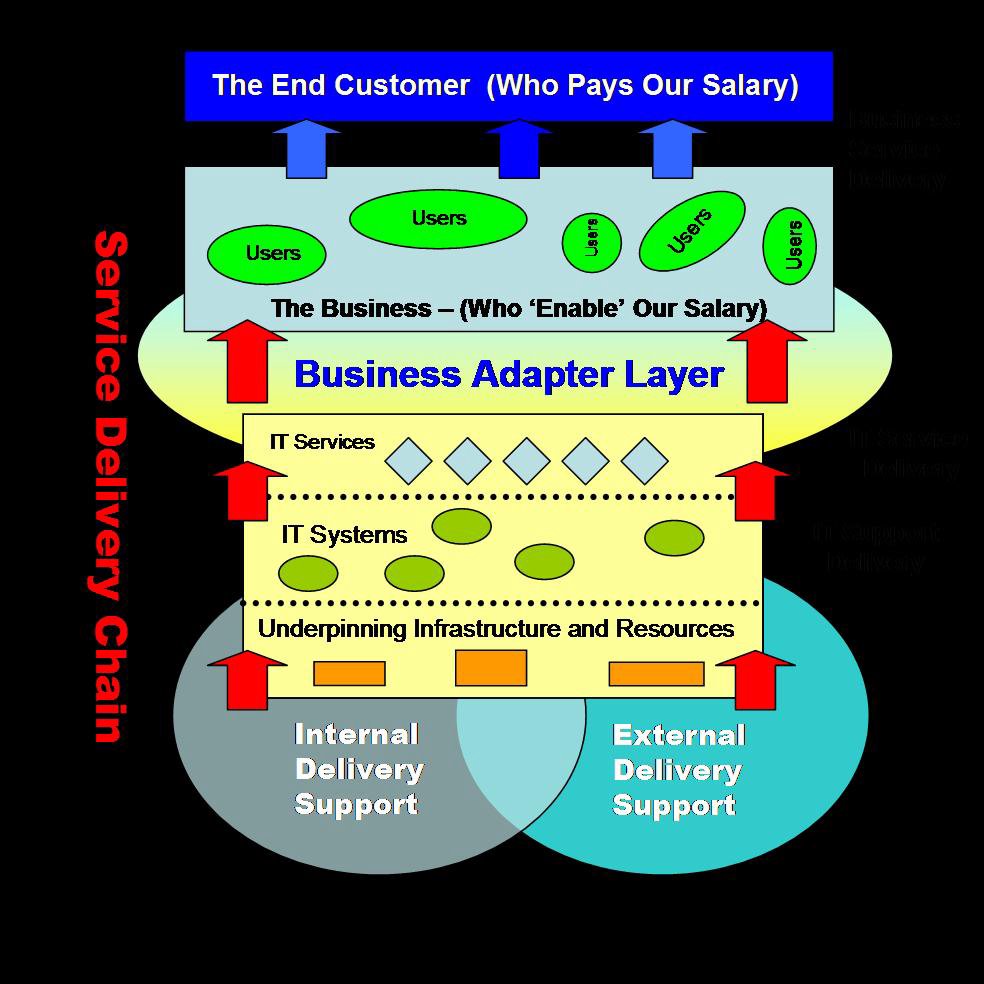
 You may remember a few articles ago that we covered the the basics of the "business adapter" layer and talked about process standardization, in the context of Service Delivery.
Click here if you need a refresher.
In today's article we explore the topics of Service Level Agreements, Operational Level Agreements, Contracts and something critical that's invasive on your ability to deliver a defined service to your business - technology enabled self-service.
We have highlighted additional quality links for you to click through to - if you need to know the detail about the three terms, and the differences between them.
HotSpot #1 - Correctly Defining Your SLA.
It is ESSENTIAL that your SLA is clearly and correctly defined, drawn up, agreed to and implemented in the knowledge that your Service delivery Organisation is geared up to deliver to these specifications - from day one. In your Customer's eyes a Service Delivery organization is often only as good as it's last mistake. With the focus firmly on the ability of your delivery organization's capability to execute to agreed standards - you really are in the spotlight from day one. Many delivery functions may temporarily 'gear up' to assure delivery to standards in the early days/weeks. This over resourcing may seem excessive but it will help to overcome minor teething challenges in the early days - especially when you execute against items in the SLA for the first time in the 'real world' e.g. month end SLA reporting.
To assist in the clear definition and agreement to the SLA - most delivery organizations now temporarily employ the services of an "intelligent business representative" - someone who has all round knowledge of the business operation that can critique the content of the SLA and ask tough questions in advance of the SLA being signed. The business representative will assist in clearly drawing up the SLA in business terms; something that usually the business has little time (and inclination) to do in-depth and, if we're honest, something that the IT Service Organization often struggles with due to a lack of detailed business process knowledge. Overall, this is an extremely effective way of 'future thinking' and often prevents issues before they impact your business... and your own organizations credibility.
HotSpot #2 - The hidden 'Overlap' between OLA's and Contracts.
Like it or not - there are conflicts of interest and hidden overlaps (in terms of people and time) between your OLA's and Contracts (delivered by Vendors).
This is an area that the next version of ITIL will help to resolve since the forthcoming new books will be written to address the very real challenges of internal V's external sourcing, when to outsource and operating in a multi-sourced environment.
The key overlap lies with your internal technical and service folks. Oftentimes they are drawn between two simultaneous pressures:- servicing the internal OLA's and supporting/liaising with suppliers against their contract delivery. If you view your organizations people/staffing structure and place a yellow dot against anyone involved in OLA's and then place an orange dot against anyone involved in supporting suppliers (in their ability to deliver agaisnt their contract) - then you may be surprised just how much this pressure is apparent in your organization. Ask your technical support manager to perform the same exercise and he may tell you a more interesting story!
To address this pressure you may wish to review:- separation of duties, assurance of vendors call on internal people's time and the extent that this overlap actually exists in your organization.
Hotspot #3 - The Control of Technology Enabled Self-Service.
Finally, we come to a more modern phenomenon - the evolution and rapid integration of self-service technology. This is the technology that your businesses true-end Customers use everyday to fulfill their requirements (in full or in part) as a result of dealing with your business.
Pseudo-Technology organizations have been breeding in business units like rabbits around such applications as automated ticketing, ARU's, Booth's and loyalty card systems for the past five years now. Get back-to-the-floor for a day and ascertain what percentage of your IT support team effort is spent on underpinning or indirectly supporting these pseudo business/technology organizations. Perhaps it's time that your Service Delivery Organization re-gained control and absorbed the pseudo-technology resources (from the business areas) back into the core of your IT / Technology Division?
Additional (and useful!) Resources:-
Steve Morgan – PTS Consulting - an excellent presentation pack on Operational Level Agreements; how difficult they are to implement; OLA content and How to Implement OLA's. (via the itSMF):-
http://www.itsmf.com/upload/conference2002/steve%20morgan%20OLA%20presentation.pdf
SLAs and Internal Contracts - an article from "beneath the buzz"; "Forming clear agreements for services and projects, the basis for accountability, teamwork, and resource management"; what goes into SLA's and Contracts:-
http://www.ndma.com/resources/ndm14413.htm
Microsoft – Technet - Service Level Agreements; an excellent resource; in depth details of SLA's and Operational Level Agreements:-
http://www.microsoft.com/technet/itsolutions/cits/mo/smf/smfslamg.mspx#E0NB0AA
Online Self-Service – Excellent Article; benefits of Self Service; Self Service Myths:-
http://www.inin.com/News/PressCoverage/presscoverage.asp?id=221
Reminder of the original article and image... click here for re-fresher
New! Visit the latest Blog from the creator of Dr. ITiL – covering ITIL Version 3 Refresh, Service Catalogs, CMDB, Foundation Exam Tips and ISO20000 Knowledge. There’s a variety of free PDF and Powerpoint downloads available to help you plan and implement ITIL.
Visit the IT Service Blog
Labels:
itil v3
Aligning CobiT, ITIL and ISO17799 For Business Benefit
Here's a 62 page little gem of a document produced jointly by the OGC and ITGI detailing much more than just how ITIL and ISO17799 maps onto CobiT. It provides a much needed management level guide as to why IT best practices are necessary and how these three best practice frameworks have evolved.
In particular, the detail around the mapping of the three standards is outstanding - a job very well done here.
In particular, the detail around the mapping of the three standards is outstanding - a job very well done here.
Labels:
itil v3
Attention All Speakers at Brighton Next Week!
In August we produced a special article highlighting the Web's best presentation and speaking hints and tips. It was published to coincide with the itSMF US Conference.
The article proved very popular with several of the first time US Conference Speakers.
In advance of next weeks UK itSMF Conference we have decided to re-publish the link.
So, if you a seasoned speaker looking for something new to spark your audiences attention, or you're a first time speaker looking to deliver a knock-out presentation click here to gain free acces to the links you need.
The article proved very popular with several of the first time US Conference Speakers.
In advance of next weeks UK itSMF Conference we have decided to re-publish the link.
So, if you a seasoned speaker looking for something new to spark your audiences attention, or you're a first time speaker looking to deliver a knock-out presentation click here to gain free acces to the links you need.
Labels:
itil v3
Back To School - Learn ITIL From The Ground Up.
Dr. ITIL has just made learning the UK Government's Information Technology Infrastructure Library (ITIL) even easier by discovering a wealth of information that's just waiting to be accessed.
Sometimes, the excellent and highly recommended OGC ITIL books are just a little overwhelming and difficult for beginners in Service Management to grasp.
But what if a more rudimentary - but fully complete - set of ITIL based practices existed. What if an entire set of FREE ITIL based processes, procedures, templates, how to guides and other resources lay waiting to be accessed?
Well they are... allow me to explain...
The British Educational Communications and Technology Agency (Becta) is the UK Government's key partner in the strategic development and delivery of its information and communications technology (ICT) and e-learning strategy for the schools and the learning and skills sectors in the UK.
Becta has helped develop FITS. This stands for Framework for ICT Technical Support and it is based on ITIL.
ITIL is derived from the collective experiences of ICT technical support providers all over the UK. It represents their learning curve over the last 20 years and has been distilled into a set of common processes applicable to any establishment using ICT.
Becta have applied these processes to UK schools, and FITS is designed to enable you to by-pass all the mistakes commonly made and implement the processes successfully from the start but at a more basic to intermediate level.
The emphasis of FITS is on proactive tasks as well as reactive ones. It views technical support not just as a function responsible for resolving incidents, but as a service provider whose main objective is to prevent incidents from occurring in the first place. We see this as the ultimate goal of technical support and we aim to help you make it happen.
There are many benefits of FITS. Here are just a few.
- It gives you the benefit of hindsight over the last 20-plus years of the development of ICT technical support techniques and is based on ITIL.
- It contains tried and tested processes that have been adapted with the school environment in mind.
- It provides simplified and ready to use processes that can be used immediately.
- It contains templates, checklists and downloads that can be used as they are or personalised.
- It has a quick-start approach to help you make the best use of time and resources available and see quick results.
- It separates administrative tasks and technical tasks to help you assign the most appropriate resources.
- It helps you keep costs to a minimum.
- It helps you protect (school) teachers from having to get too involved in technical support issues.
Before you go overboard at finding this superb set of resources - please remember:-
- This is a much more basic to intermediate view of ITIL. It is perhaps not comprehensive enough for most commercial organisations.
- Some of the advanced detail available from the OGC is not replicated within FITS, so care should be taken when using the material to base your entire multi-million dollar ITIL investment strategy?!
However, it has several other advantages:-
- It is easy to get into!
- It is easy to absorb and appreciate the core concepts (if you're new to ITIL).
- It is a rudimentary ITIL resource enabling you to swiftly move onto the bigger stuff armed with a solid appreciation from the 'grass roots' up.
- It is easily accessible, intuitively laid out and well hyper-linked.
- It is presented in a complete "case study" scenario... Schools Technology.
FITS is ideal for more junior staff to begin learning about ITIL too. Ed note - From the feedback we have received it is interesting to note that perhaps some CXO's new to ITIL would also pay a sneaky visit to get up the learning curve faster ;>
Which ever way you look at it - FITS is a great 101 primer in ITIL - and it's FREE!
Begin your FITS journey here...
Sometimes, the excellent and highly recommended OGC ITIL books are just a little overwhelming and difficult for beginners in Service Management to grasp.
But what if a more rudimentary - but fully complete - set of ITIL based practices existed. What if an entire set of FREE ITIL based processes, procedures, templates, how to guides and other resources lay waiting to be accessed?
Well they are... allow me to explain...
The British Educational Communications and Technology Agency (Becta) is the UK Government's key partner in the strategic development and delivery of its information and communications technology (ICT) and e-learning strategy for the schools and the learning and skills sectors in the UK.
Becta has helped develop FITS. This stands for Framework for ICT Technical Support and it is based on ITIL.
ITIL is derived from the collective experiences of ICT technical support providers all over the UK. It represents their learning curve over the last 20 years and has been distilled into a set of common processes applicable to any establishment using ICT.
Becta have applied these processes to UK schools, and FITS is designed to enable you to by-pass all the mistakes commonly made and implement the processes successfully from the start but at a more basic to intermediate level.
The emphasis of FITS is on proactive tasks as well as reactive ones. It views technical support not just as a function responsible for resolving incidents, but as a service provider whose main objective is to prevent incidents from occurring in the first place. We see this as the ultimate goal of technical support and we aim to help you make it happen.
There are many benefits of FITS. Here are just a few.
- It gives you the benefit of hindsight over the last 20-plus years of the development of ICT technical support techniques and is based on ITIL.
- It contains tried and tested processes that have been adapted with the school environment in mind.
- It provides simplified and ready to use processes that can be used immediately.
- It contains templates, checklists and downloads that can be used as they are or personalised.
- It has a quick-start approach to help you make the best use of time and resources available and see quick results.
- It separates administrative tasks and technical tasks to help you assign the most appropriate resources.
- It helps you keep costs to a minimum.
- It helps you protect (school) teachers from having to get too involved in technical support issues.
Before you go overboard at finding this superb set of resources - please remember:-
- This is a much more basic to intermediate view of ITIL. It is perhaps not comprehensive enough for most commercial organisations.
- Some of the advanced detail available from the OGC is not replicated within FITS, so care should be taken when using the material to base your entire multi-million dollar ITIL investment strategy?!
However, it has several other advantages:-
- It is easy to get into!
- It is easy to absorb and appreciate the core concepts (if you're new to ITIL).
- It is a rudimentary ITIL resource enabling you to swiftly move onto the bigger stuff armed with a solid appreciation from the 'grass roots' up.
- It is easily accessible, intuitively laid out and well hyper-linked.
- It is presented in a complete "case study" scenario... Schools Technology.
FITS is ideal for more junior staff to begin learning about ITIL too. Ed note - From the feedback we have received it is interesting to note that perhaps some CXO's new to ITIL would also pay a sneaky visit to get up the learning curve faster ;>
Which ever way you look at it - FITS is a great 101 primer in ITIL - and it's FREE!
Begin your FITS journey here...
Labels:
itil v3
Dr. ITiL Reaches the Four Corners of the Globe
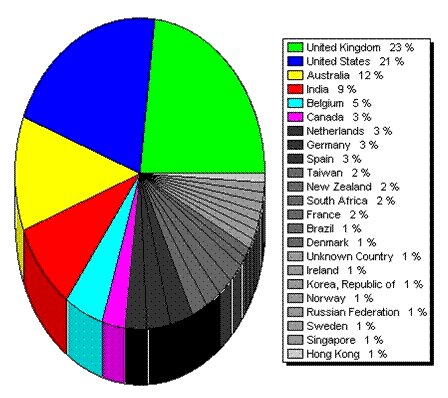
Above is a visitor profile, captured today, showing that Dr. ITiL reaches the four corners of the globe. With over 16,000 visits in October and an average visit duration of just over 3 minutes per day - it's further proof of the growing interest in all things ITIL.
The profile does vary, depending on when you view it - for example from 1400 (GMT) the majority of visitors are from the US - and so the percentage figures change - but you get the idea.
The fastest growing areas of interest are from India and Taiwan.
Take A Look At These 29 Process Guides...
We have uncovered the location of 29 essential guides to process management covering the spectrum of ITIL disciplines.
Each guide is FREE to access using the link below.
Whether you are looking for further inspiration as to how to continue to improve your processes - or you are brand new to ITIL - look no further.
Please note - guides listed in GREEN are aimed at advanced practitioners only. The concepts covered are complex and should only be reviewed by experienced ITIL people.
Anyway, to give you an idea, here's the full list:-
1. Process Management
2. Developing Robust Processes
3. Establishing Mutually Beneficial Process Metrics
4. Change Management—Part 1
5. Change Management—Part 2
6. Change Management—Part 3
7. Audit Reconnaissance: Releasing Resources Through the IT Audit new
8. Problem Management
9. Problem Management–Part 2: Process Design
10. Problem Management–Part 3: Process Implementation
11. Business Continuity Emergency Communications Plan
12. Capacity Planning – Part One: Why It is Seldom Done Well
13. Capacity Planning – Part Two: Developing a Capacity Planning Process
14. Capacity Planning — Part Three: Benefits and Helpful Tips
15. Capacity Planning – Part Four: Hidden Upgrade Costs
16. Improving Business Process Management, Part 1 new
17. Improving Business Process Management, Part 2 new
18. Major Elements of Facilities Management
19. Major Physical Exposures Common to a Data Center
20. Evaluating the Physical Environment
21. Nightmare Incidents with Disaster Recovery Plans
22. Developing a Robust Configuration Management Process
23. Developing a Robust Configuration Management Process – Part Two new
24. Automating a Robust Infrastructure Process new
25. Improving High Availability — Part One: Definitions and Terms new
26. Improving High Availability — Part Two: Definitions and Terms new
27. Improving High Availability — Part Three: The Seven R's of High Availability
28. Improving High Availability — Part Four: Assessing an Availability Process
29. Methods for Brainstorming and Prioritizing Requirements new
(Guides highlighted in GREEN are for advanced practitioners)
Access the FULL 29 Process Guides Index
Each guide is FREE to access using the link below.
Whether you are looking for further inspiration as to how to continue to improve your processes - or you are brand new to ITIL - look no further.
Please note - guides listed in GREEN are aimed at advanced practitioners only. The concepts covered are complex and should only be reviewed by experienced ITIL people.
Anyway, to give you an idea, here's the full list:-
1. Process Management
2. Developing Robust Processes
3. Establishing Mutually Beneficial Process Metrics
4. Change Management—Part 1
5. Change Management—Part 2
6. Change Management—Part 3
7. Audit Reconnaissance: Releasing Resources Through the IT Audit new
8. Problem Management
9. Problem Management–Part 2: Process Design
10. Problem Management–Part 3: Process Implementation
11. Business Continuity Emergency Communications Plan
12. Capacity Planning – Part One: Why It is Seldom Done Well
13. Capacity Planning – Part Two: Developing a Capacity Planning Process
14. Capacity Planning — Part Three: Benefits and Helpful Tips
15. Capacity Planning – Part Four: Hidden Upgrade Costs
16. Improving Business Process Management, Part 1 new
17. Improving Business Process Management, Part 2 new
18. Major Elements of Facilities Management
19. Major Physical Exposures Common to a Data Center
20. Evaluating the Physical Environment
21. Nightmare Incidents with Disaster Recovery Plans
22. Developing a Robust Configuration Management Process
23. Developing a Robust Configuration Management Process – Part Two new
24. Automating a Robust Infrastructure Process new
25. Improving High Availability — Part One: Definitions and Terms new
26. Improving High Availability — Part Two: Definitions and Terms new
27. Improving High Availability — Part Three: The Seven R's of High Availability
28. Improving High Availability — Part Four: Assessing an Availability Process
29. Methods for Brainstorming and Prioritizing Requirements new
(Guides highlighted in GREEN are for advanced practitioners)
Access the FULL 29 Process Guides Index
The "Secrets" Of Passing Multiple Choice Exams...
 Over at www.FoundationSuccess.com there's a three part article revealing the "secrets" of passing multiple choice exams which will prove inteteresting reading for anyone who's about to sit their ITIL Foundation Exam.
Foundation Success was launched this week and is set to become an important resource for all prospective and active ITIL foundation students.
We're not giving away any of the secrets here... but they will statistically beat 'guessing' and 'gut feel' that's for sure.
Foundation success contains several quality articles and links to ITIL Foundation study guides, examination tips, free sample exam papers, online ITIL questions and much more!
At the end of the day though - there's never any substitute for hard graft and revision... but at least now there's a decent study companion... www.FoundationSuccess.com
Subscribe to:
Posts (Atom)


 Posts
Posts

