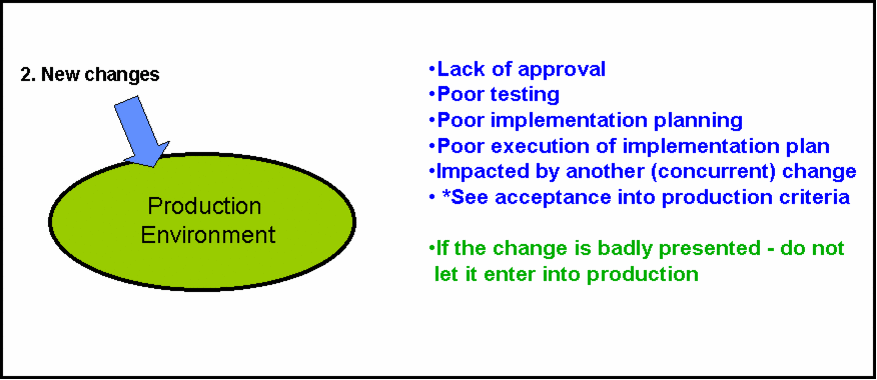
The Seven Sources of Problems #2 - New Changes


We continue our tour around the clock today with a look at the next source of Problems - "New Changes", writes Robin Yearsley.

Please note - I have deliberately separated out "upgrades and Patches" as the next Source of problems which we will cover tomorrow.


Strictly speaknig they are - and should be - classed as "New Changes" but for reasons we'll go into tomorrow we have created a separate 'source' for them. Please bear in mind that these criteria for "New Changes" also apply to "upgrades and patches"

So how do Changes cause Problems?

Well, strictly speaking they don't!


Failed changes cause incidents, incidents are resolved - with service restoration taking place - then the underlying root cause is assessed / analysed and then eliminated through Problem Management.

Great Changes don't cause problems. They enable improvement.

Now, we won't get bogged down with the strict ITIL workflow here but we're going to focus on what you can do to prevent (or minimise) the ultimate source of problems: "New Changes".

There are several key reasons often cited, we discuss each one here...

Lack of approval:-

The change did not receive the appropriate level, duration, depth or quality of review prior to approval. The result - the change is (often unwhittingly) mis-approved. Think of it as a time-bomb. It's now been approved (armed) and it's heading for your production environment. It should have had some aspect of it validated or raised as an objection during a CAB meeting or senior level approval meeting - but this didn't happen. So, some impact is going to happen as a result.

Tackling this challenge is best done through your CAB meetings, but you can also create special "advisory" groups who pre-approve forthcoming change packages prior to it going into the full CAB for final approval. Such advisory froups will generally focus on specific elements of change such as the "Technical Design Group" or the "High Availability Group". You should aim to create several of these groups but tag the responsibility onto a group that already exisits to avoid internal warfare/politics about the (alledged) resource utilisation of your Change Process.

Remember - all change involves some degree of risk. You will NEVER be able to consider all possibilities - you just need to ensure that your Change Process and the people who facilitate and approve changes are provided with the best information and the best opportunity to mitigate any risks prior to implementation.

Poor testing:-

It amazes me how often poorly (or un-tested) changes are approved to enter production. One classic reason for this is because the CEO shouts loudly and wants some new functionality in place ASAP! Everyone beneath the CEO suddenly cuts corners, moves mountains and drives the change through in double quick time - missing all the appropriate check-points. There's not much science here: poor testing = higher risk change. It's that simple. Plus - CEO's shouting loudly will not alter this risk factor. Ask yourself the question - How loud will they shout if all your systems fail and your organization takes a massive 'hit'? You need strong IT leaders to stand up, be counted and present the risks in the correct way. Reasoned discussion leads to reasoned decisions.

Another factor lies within the testing methodology itself. Are the right skilled resources carrying out the testing, are the testers allowed enough quality time to implement a fix to any given bug, are testers influenced by teh business to much? The list goes on... but the consideration is simple - the quality of your testing function is directly proportionate to the quality of the change package that you are expected to implement.

Poor implementation planning:-

Do your changes come attached with a thought out and walked-through quality implementation plan? If the change is of any reasonable size - have the implementation team walked through it with the Change team to review the key stages and ensure that all appropriate support activities are in place? There's no substitute for great planning. It prevents the pain of production issues.

The best Change teams ask difficult questions, especially "What if this happens...", type questions. If it's badly planned and thought through - don't let it in!

Poor execution of implementation plan:-

The ironic thing is - the best laid plans, poorly executed, are a waste of time. The best laid plans also need to be flawlessly executed. If things go wrong, as they often do, small implenmentation workarounds and fall back positions should have already been identified and documented read-to-go.

The best advice I can give about plan execution is this - have the best person for the job in charge of ensuring timely and accurate progress against the plan - but if things fall away too fast - that person knows when to effectively 'pull the plug' on the change and restore normal service. The best person will not carry on regardless.

Impact of another (concurrent) change:-

Mmmm, do you really know everthing that's going on?


For example will the facilities folks be testing the UPS systems over the weekend and therefore when your technical guys try to implement their new system - there's no power available!?

For Change Management to be really effective - you need to have what we call,
"One complete version of the truth".

All change programmes should ultimately 'come together' into this one version - preferably onto one high level change plan. This activity can actually drive up the quality of Changes too - since it means IT and Technology folks have to talk regularly with their change business counterparts - about change!

I've lost count of the number of times Change teams have identified 'risky' change going on elsewhere when the IT folks were also planning a change.

So, what else can we do to prevent "New Change" being the sources of Problems.

Well, there are two final prevention items that can be employed:-

1. Your acceptance into production criteria.
- Did the change pass all pre-production criteria?
- Did the change get approved by the right folks?
- Did the change implementation plan get walked through (or did it sail through?)

2. Playing it tough.
- Learn to say 'no'.
- If you can't (or are un-empowered too) - get someone on your side who can.


The bottom line with this particular source of Problem is this:-

If the change is in bad shape - it enters production at your peril!

Tomorrow, we'll move onto look at a very special sub-set of Change: "upgrades and patches", which we believe deserve it's own special Source number (#3).

In the meantime, if you have any comments about this article, please feel free to share by posting a comment below.

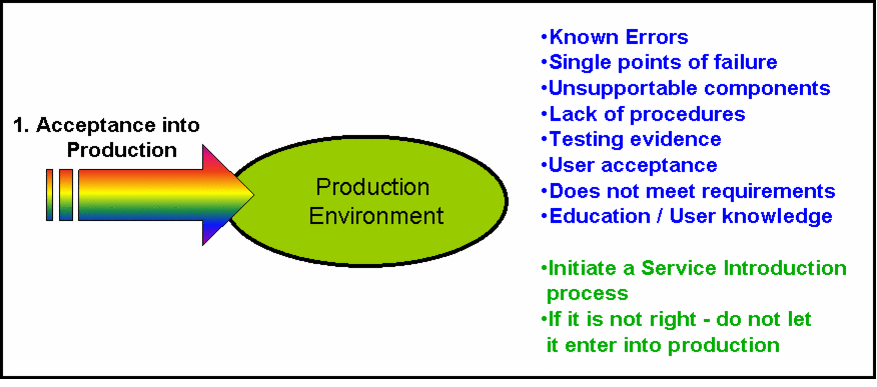
The Seven Sources Of Problems #1 - Acceptance Into Production

Yesterday, we looked briefly at the Seven Sources of Problems and went 'around the clock' to get a general feel for what each source means.

Today, we begin to work our way around the clock starting with source #1 - Acceptance into production.

The multi-colored arrow is deliberatley multi-colored to represent the fact that any of the other 6 sources of problems could actually enter via this route into production and therefore cause a new problem.

The arrow is also 'broken' (left hand side) to represent that fact that generally most advanced IT Service Organizations have installed several "Quality Gates" to perform various checkpoints (say at design sign-off, or at the end of testing).

Such "Quality Gates" are meant to prevent poor quality systems and badly produced support documentation in the first place.

The ultimate aim here is to ensure that when the system reaches the final gate for introduction into production - it is known, supportable, the people are ready to begin supporting it and the services to maximise the value of the system for the business are in place and functioning correctly.

As we know all too well, quite often these types of tasks are either sacrificed if projects begin to run late - or - performed at the very last minute giving the impression that the system is "thrown over the fence" into production. This places undue pressure on Service Organizations and creates a reactive support environment. This, in turn, actually drives up the likely volume and frequency of problems due to inherent instabilities and inherent weaknesses in support capability. Service Level Agreement penalties are also prevalent.

So, what's the bottom line here? More problems occur when the support services for a new system (in the widest context) are not in place, rehearsed and the people present are capable of delivering that service.

So, what can we do about this situation?

Lots!

Here is a summary of some proactive actions that can be executed during the forthcoming system/service introduction - to prevent the above chain taking place:-

Known Errors:-

- Ensure that the Problem Management team have full visibility of all known errors way before the system goes live.
- If you can, allocate resource to proactively work with system and service testers to enable a better picture of the types, volumes and possible impacts that known errors might cause. Have that reources work dilligently with the testing folks to drive out as many known errors as possible.
- Use a risk/impact/exposure matric to ensure that the highest known errors are being tackled in the correct priority.
- Inevitably there will be some known errors that have to be accepted into production - but the key message is that they should be KNOWN, documented, service restoration workarounds already in situ as well as the support folks are per-educated to execute the restoration procedures.
- Finally all known errors should have a follow-up plan stating when their root cause will be eliminated and what resources/timescales are involved in doing so. Essentially, everything must be KNOWN.


Single Point Of Failure (SPOF) Analysis:-

- Involves identifying the weaknesses in a system or service design and either rectifying that weakness of eliminating it altogether.
- There is obviously a cost involved in installing highly resilient/redundant Infrastructure. Sometimes the business case doesn't fly with lots of expensive duplication options - so single units are opted for instead.
- Often the single points of failure are much more suble. They can be single filesystems that drive a new application, as opposed to actual hardware. SPOF's can also apply to human beings too!
- Think through if you have any single pojnts of people failure or single points of knowledge failure. Is there just one person who knows how to restore service for a given system?
- First identify your SPOF's, then risk assess them, then work to eliminate or reduce them to an acceptable level.
- If the resulting overhang is still looking risky - make sure that any SLA's you sign up to reflect the level of risk - in particular if it could impact availability.


Unsupportable Components:-

- It's often the case that many months after a system has gone live there is a component failure that no-one can fix anymore.
- Probably because the support resource has left the company or moved on, but also because the Vendor (with whom you have an underlying contract) has subsequently removed it from it's support portfolio.
- Even more subtle than this - is how Versions and Releases of components fall off a Vendor's support portfolio. Once again - list all components, ensure their supportability, keep a special calendar for upgrade paths and when certain version fall off the Vendor's support portfolio.
- This may seem like a lot of work and it is. However the overhead is made much easier when this approach is integrated into your Configuration Management Database structure. Each component CI should have these items recorded and tracked. Validating unsupprotable components then becomes as easy as producing a report.
- Where unsupported components ARE found - you need a supportability plan to execute against it. - If it's in production - it must be capable of being supported.


Testing Evidence:-

- Ensure that your Service folks get a good chance to review the results of any tests - before teh testing cycles complete. Getting a feel for the types of failures in testing and the remedial work necessary to overcome these bugs will provide a general indication about what types of problems can be expected later on.
- Keep in mind there will always be surprises!


User Acceptance:-


- Spending quality time ahead of implementation with your user community can also pay dividends.
- Get a feel for what kinds of bugs and issues your users are identifying

Does not meet (business) requirements:-

- If the end system does not do what it's supposed to do, say for a menu sub-option, and it's managed to creep it's way through testing and UAT, then it's going to hit the Service folks as a problem at some stage. Ensure via testing and user acceptance that the forthcoming system has been signed off and approved, in as many aspects as possible, by the business.
- Not meeting requirements also leads to a high level of early changes (post implementation). Such high volumes often lead to change failure (see source #2)

Education / User Knowledge:-


- Gaps in user education and knowledge oftne means that end users will quickly find local ways around overcoming the shortfalls in their new systems capabilities
- Such Gaps are often overcome in two ways: The use of excel spreadsheets (to manipulate data and perform calculations) and manual data manipulation. Both can cause considerably challenging Problems where the output produced does not match the desired business outcome or does not adhere to the business process/rules
- Gaps are important and should be closed as far as possible prior to acceptance into production

Finally, to wrap up today's post on source #1 - acceptance into production, we leave you with two guiding principles:-

(i) Implement a strong and well adhered to "Service Introduction" Process - to prevent poor quality and unsupportable systems entering production in the first place

(ii) Ensure Leaders have the strength of character to be able to say, "No", to new systems implementation - when there is enough evidence that an unnacceptable level of risk to the current operation will be introduced IF the new system is implemented.

In the next post, we will learn more about source #2 - Changes.

In the meantime if you have any comments or just wish to share your thoughts on the above topics - please post them below.

Spicing Up ITIL Reports - We're Only Human.

ITIL is big on reporting, as you well know, because you've read the books. There are scores of reports that could be produced across each service process.

The 'trick' (in this e-mail crazy day and age) is to obtain your fair share of Senior Management / CIO 'mindspace' by utilising a number of canny illusions to get the results that you're looking for.

Let's take Change Management as the example throughout...

1. The Traditional Content of (Boring / Unread) Change Reports:-

-Number of change requests
-Number and percentage of changes (rejected - emergency change - in change status)
-Number of change awaiting implementation, by category and time outstanding
-Number of Implemented changes, by configuration component and service
-Change backlogs and bottle necks
-Cost per change
-Business impact of change
-Changes by business area
-Frequency of change to CIO's

2. The Results of Traditional Content of Change Report:-

-Your report flies around the e-mail system, lands into multiple in-boxes and is quickly deleted
-Your report is not read
-Therefore No action is taken
-The very next week - things are the same (if you are lucky!)

Continuous improvement is actually hindered by the lack of attention and time spent on essential reviews of management information - do you recognise this symptom?

So, what are the root causes?

-Your report is boring!!
-Your report contains too much data and not enough information
-Your report does not contain a narrative about the decisions that are taken/recommended
-Too much data by e-mail => loss of interest
-CIO says, "This is the Change teams job isn't it?"

So, what can we do about it?

3. Dr. ITiL's Prescription for Positive Change (or "things to try!")

-Produce a one-page scorecard... not a boring report (the detail can go underneath)
-Use color (red, amber, green, blue)

-Use charts with Meaningful Headings that look purposeful and make sense
-Use peoples names... make it personal - for maximum effect

-Use a powerful narrative, "This Chart clearly shows that the current statistics gave exceeded our target threshold and therefore the following action will be taken..."

- Use exaggerated color highlights where run statistics cross trendlines
-Try to produce a last week, last month, last quarter summary on one page

-Leave color copies on peoples desk once in a while rather than send by e-mail
-Hand the scorecard out once a week in the CAB meeting, discuss it before you begin the detailed stuff


What works for you? Please feel free to add your own comments / best practices / ideas by posting a comment below....

HP Buys Peregrine for $425M - UPDATE

Probably the biggest news to come out of last week was HP's decision to purchase Peregrine Systems for $425M. This has effectively bought HP much closer to their IT Service Management (ITSM) Customers by purchasing Peregrine's excellent core software products including: ServiceCenter, AssetCenter and the various underpinning tools that enable self-service, auto discovery and of course, the icing on the cake, one centralised (all seeing, all knowing) integrated CMDB which works across the products.

HP's website did originally have a link embedded within their press release, which has subsequently been changed, which (to us) read like an internal briefing note - so perhaps there was a little bit of early confusion about what was an "internal" V's an "external" link. Nevertheless, the original link took us through to a Q&A page that outlined what would happen to the Peregrine products next.

Our take, here at Dr. ITiL, was that ServiceCenter's 'best features' would quickly be integrated into HP's core OpenView architecture, whilst AssetCenter appeared to be the real prize. In our view, the original link also talked postively about the future of the Peregrine team - rather than hinting at job losses.

Current Peregrine Customers are typically large scale Enterprises who already have considerable investment in either HP technology or HP's Openview - so it's just a matter of understanding the overall roadmap and how the integration of these technologies might work.

For companies that use alternative product suites to AssetCenter - it's going to lead to an interesting investment decision about migrating to the overall HP platform. The saving grace might just be the payback or ROI in Peregrine's Auto-Discovery and Centralised CMDB technology.

HP's move was a bold one - and one that has really boulstered it's position in the marketplace, as well as taken HP a step closed to more of it's existing as well as 'nearly' Customers.

It will be interesting to see how IBM react. The most natural step would be for IBM to purchase Mercury for it's Business Systems Management technology, and integrate that into the overall Tivoli suite. The 'fit' appears good, on paper at least.

Mercury have been going through a tough time though recently with them admitting that they will have to restate earnings from 2002, 03 and 04 (from the press releases we read, anyway). This has had an adverse affect on their share price. Nevertheless they have a powerful suite of ITIL related products - including their excellent IT Governance Center.

Perhaps IBM is waiting in the wings to snatch a better bargain?

Further Coverage:-

http://managementsoftware.hp.com/news/press/pr/2005/pr_0089.html

http://www.informationweek.com/story/showArticle.jhtml?articleID=171200367&tid=5979

http://www.signonsandiego.com/news/business/20050925-9999-1b25prgn.html

Mercury to restate Earnings

Get The Edge - ITIL Exam Tips

Today, Dr. ITIL is pleased to publish it's updated Exam Tips Article first published in March this year. We have added more tips and more links for further information on how to tackle the ITIL Managers (Masters) Exam.

To check out hints, tips and sample questions for the ITIL Foundation visit:-
www.FoundationSuccess.com

As well as learn the essentials of each individual process, you will beed to understand the linkages and synergies of each process. You will gain extra marks - where relevant! - for simply describing this.


Some general tips:-


- Use ITIL terminology throughout - but use it correctly.

- Answer the question that's asked. NOT the one that you think is being asked. Just because you see the phrases "Problem Management" and "benefits" doesn't always mean that's the main thrust of the answer.

Next, read the context of each question three times and ensure that you get to answering it straight away. Examiners reports always make reference to the fact that a large number of students do not read the question properly.

- Avoid explaining what hasn't asked to be explained. Just because you know all there is to know about, say Change Management, is irrelevant when you have been asked to explain how Change is linked to config. Answer what's really being asked. Examiners regularly highlight poor writing style and 'waffle' as being distracting. So my advice would be to keep it clear, concise and simple. Go for the marks!

- If you have pre-start reading time - use this wisely. Immediately eliminate any questions that you will truly struggle with. Select your strongest 3/4 questions first and think through the structure of your answer carefully.
Save 1/2 questions that you can get away with listing things for, say the benefits of Incident Management. Saving list type questions will help you 'bag' some late marks when time's running out.


More ITIL Specific tips:-

- Answer your questions in the ITIL way - not the way you necessarily do it in real life. The examiner does not know your organisation but (s)he DOES know the syllabus for the examinations.

- Learn the benefits and advantages of each process

- Learn the disadvantages/challenges of each process

- Learn how to implement all of the processes

- Learn those generic items that are pretty much standard whichever process you implement, there is a pattern

- Learn the interface points, the outputs of one process to the inputs of another. Learn how - when implemented together - they generate further benefits for the organisation

- Learn the "desired results" that
organisations/management are looking to achieve with ITIL processes

- Leave some space in your answers where you can fill it in later with additional supporting points

- Leave yourself some time before the end of the exam to re-read your answers - but do it from an ITIL examiners perspective

- Know the boundaries of ITIL, where ITIL effectively ends and another (e.g. COBIT, Six Sigma) begins. You don't need to know the other process in ANY detail, but simply understanding how far you can take ITIL before you need to employ the methodologies of another process is beneficial.


Running out of Time?

If you find yourself running out of time, don't panic:-

- Select the answers that score the most points!

- Use bulleted lists for maximum coverage with minimum words

- Hand your rough notes in with your answers papers - but write some "labels" on them - highlighting to the examiner that you were planning to include these points for specific answers. You may tip the balance if the examiners is thinking about giving you the benefit of the doubt for an answer


If you're sitting your exams soon - May We Wish You The Very Best of Luck- but with solid preparation and taking on board these tips - you won't need it will you ?!

New! Visit the latest Blog from the creator of Dr. ITiL – covering ITIL Version 3 Refresh, Service Catalogs, CMDB, Foundation Exam Tips and ISO20000 Knowledge. The
re’s a variety of free PDF and Powerpoint downloads available to help you plan and implement ITIL.

Visit the IT Service Blog

Are You an ITIL Black Belt?

Dr. ITiL presents Paul Underhill's excellent presentation on how ITIL can be implemented like a martial art!

Paul says, "We all know how difficult it is to effect change, especially when trying to implement ITIL.

Adopting the ancient lessons taught in martial arts, of balance, patience, yielding or striking only when the time is right, directing not controlling, connecting not attaching, starting something with its opposite etc, can help us all ensure success even in the modern world of IT Service Management."
“Don’t take a horse to water and expect it to drink - first make it thirsty” - exactly Paul.

Conference Coverage:- Day 3 - Lakeside Final Report


Mary C. Jozsi's final Day at the 2005 itSMF US Conference:- Today (of course) was shorter, but non-the-less still filled with a lot of great information!

I attended the workshop IT Organizational Structures: The Good, The Bad, The Ugly. We know we want the right people in the right place, but I wanted to know how to tell for certain if that’s what’s there.

I wanted strategies to determine whether or not it is, and options to minimize the impact if it’s not. I was not disappointed.

Elizabeth Schlier and Gary Glassman brought us through a lot of information that I will not only be able to use in the future, but also got me thinking about past organizations I’ve seen and what might have been done differently (applying what I learned).

The session ITIL – Can you scale it down? Was also very interesting. While I don’t have immediate plans to implement an ITIL framework in a very small organization, I do feel it’s interesting to explore how to implement best practices and an ITIL framework in an organization that is not the typical very large company that we’ve done a lot of talking about.

Looking at the other end of the spectrum gives us a different way to view implementing the ITIL framework so that we can be successful by implementing using processes that work for the organization we’re working with.

Again, the ending keynote was great. Ravi Nannapaneni left us with some great thoughts about why it’s great to be in IT, why IT needs to be a Service Business, and why it’s so important to do it right.

I hope everyone who attended the conference enjoyed it and got as much out of it as I did.

A final note about the facility. McCormick Place is always a great place to have a conference, but I’d like to share what just “made it” for me. As many of you already know, McCormick Place Lakeside Center (or East) is right on Lake Michigan and has a beautiful view of the lake and of downtown Chicago – especially on a nice day.

I am sitting on the lake enjoying this view as I write this. (In spite of being a life long Chicago area resident, I can count on one hand how many times I’ve done this.) This time made possible by the location selected for the conference and the nice weather we are experiencing in the Chicago area.

Mary C. Jozsi
Senior Consultant.
Delta Initiative LLC.

Conference Coverage:- Day 3 - Software Thinking

Further Conference Coverage From Don Casson, CEO, Evergreen Systems INC.

Hi Guys,

I continue to be primarily show floor bound!


What I have noticed is a fair amount of innovative software thinking on the periphery of the core, established service management suites.

Areas to explore further are more intelligent approaches to automated discovery and reconciliation of IT asset information, innovation in the areas of service catalogs and general pre-packaging of service workflows, and more thinking around how to help the IT organization use (decisioning) the data that for some is now being gathered and stored consistently over time.

Another of the questions we asked on the ITIL maturity benchmark was, “Describe the speed at which ITIL awareness is rising with senior IT management (of your company) over the past 12 months.” Choices included not at all, slow, moderate, rapidly, and very rapidly.


From a quick scan of the data, 75% of the responses appear to be either moderate or rapid, with those being roughly even. Moderate is not bad, and rapid is ok too. The good news is the pace is good enough to sustain the momentum, as ultimately any grassroots ITIL service management.

Cheers,

Don Casson

www.evergreensys.com

EXTRA - Conference Coverage - Michelle Hudnall

CMDB - Maximum Value, Minimum Number of Records!

Reported by Michele Hudnall, director of Service Management, Managed Objects.

Configuration management, not surprising, is central to of many of the sessions, vendor solutions and questions from the attendees at itSMF this year. The CMDB is the key that enables IT organizations (ITOs) to speak to their business units in terms of demand, capacity, usage, cost and value of services rather than technologies.

Projects discussed at itSMF are not generally a "CMDB project," but rather a CMDB supporting the development, management and communication of business services and/or in response to compliance and regulatory governance.

Common themes that perplex most ITO's – especially here seem to be:
- How wide and how deep should my CMDB be?
- What precisely is a CI?
- Where do I begin building a CMDB?
- Should I have one physical database or a federated database? (See federated vs. centralized:
http://makeashorterlink.com/?R454225DB
- If federated, then how do I integrate?

In breaking this topic down, the purpose of the CMDB is to illustrate "relationships" logically to understand the driving questions of governance and services in support of managing technology services balancing cost/value and capacity/demand.

The purpose is not to become a single physical database, which requires duplication of management data (problem, incident, change, availability, etc.)

The answers I’ve heard at itSMF to the questions above seem to point out that the most successful approaches are those organizations that understand the value of managing the processes with supporting technology, while simultaneously integrating across process and technologies. Leveraging technology that enables integration for relationship views (shallow), while deep process information is managed at its source.

Pitfall themes to CMDB projects seem to be when organizations go too wide (end-to-end IT services), too deep (duplication of data managed in other technologies) and do not keep to the objective of the project (service views, governance, relationship mapping). The relationship view representing the relevant pieces of data from various management technologies and sources will provide the most value.

As ITIL states, "maximum control, minimum number of records."

Recommended reading:
Network World: Configuration management databases take center stage:-
http://makeashorterlink.com/?P634315DB

Network Computing: IT Best Practices With ITIL:-
http://makeashorterlink.com/?P274525DB

Network World: A closer look at ITIL:-
http://makeashorterlink.com/?Z284615DB

CIO Government: ITIL Be Alright on the Night:-

http://makeashorterlink.com/?U294255DB

About Managed Objects Managed Objects is the Business Service Management Company. Business Service Management (BSM) aligns IT with the business by integrating network, system, application, end user, and business metric information into real-time business service dashboards. Through Managed Objects' BSM platform, companies effectively monitor, manage, and report on the services IT delivers to the business - services like online trading and e-commerce. Consistently acknowledged by the analyst community as best in class, Managed Objects has more BSM implementations in place than any other company. That is why AIB, Auchan, CSC, Credit Suisse, DISA, Fidelity Investments, JPMorganChase, NIH, Progress Energy, Reuters, TIAA-CREF and other global organisations rely on Managed Objects' BSM technology.

For more information, visit www.managedobjects.com

itSMF Conference - Second Day Coverage!


Today on Dr. ITiL - we can learn more about the second days news, presentations and behind the scenes goings on.

If you attended the conference - please feel free to post your own additional comments.

Conference Coverage:- Day 2 - The One About Gorillas

By John Worthington.

Spent most of today ‘walking the halls’, but did get a chance to see Chip Bell’s message on Partnering: The Secrets of Great Relationships.

What a way to start the day!

An entertaining and very useful keynote that really highlighted the importance of SLM and managing the customer relationship….it’s so easy to skip these critical elements of ITSM since it is very often not part of IT’s comfort zone, but it can make or break success as much as Incident, Problem or any of the core process areas…

I particularly liked his story about the Gorillas, which I’ve tried to summarize below...

Four gorillas were trained to not touch bananas when lowered into their cage, by squirting a fire hose at them. They eventually learned not to touch the bananas or they would get wet.

When a new gorilla was switched with an existing (trained) gorilla, the other gorillas would stop the new gorilla from getting a banana so they did not get wet.

Eventually, all the gorillas were replaced, even though the fire hose had never squirted them. The behavior was embedded in the group even though it was no longer necessary.

The point was, ‘how do we know when a process loses its relevance?’ A silo-ed approach to management is no longer effective, yet many (unenlightened) still keep people, process, products and partners in (often guarded) silos. Continuous improvement asks whether what we’re doing is still relevant to the business…

While I did not get a chance to see other sessions, I was able to tour the show and talk to many exhibitors. What a wealth of information!


Most of the feedback I got from both exhibitors and customer attendees was that there was pretty good focus of interests and I got the sense that the show was proceeding very much to everyone’s satisfaction.

I was able to explore more about how performance data is being leveraged in ITIL implementations and will continue this research and ‘blog it’ when I’m able.

Enjoy the show!


By John Worthington.

Conference Coverage:- Day 2 - Going Really Well

Day 2 was another day full of great presenters with a lot to tell us - writes Mary Jozsi.

I started with the 7:30 Breakfast session Trends and Best Practices in Service Level management which gave us information about Service Agreements, including results on Oblicore’s latest SLM survey.


At a high level, the results indicate that a vast majority of companies have SLAs, a majority of those feel that the number of SLAs will increase next year, and over half of them claim to over deliver services to meet the SLAs. (hm, sounds familiar – I’ve seen it in practice a few times.)

Again today, I felt that I got something out of every session I attended, but I’ve got to tell you, I thought Stephanie Peterson’s session on Organizational Readiness and ITIL: how to Ensure your ITIL initiative will succeed was fantastic.


She is a dynamic presenter and kept the audience’s attention with what appeared to be no effort at all. We left with a list of questions that can be asked to assess where an organization is at. For determining if project goals are met, the recommendation is to have one measure of success that ties back directly to the business reason the project is being done.

I was able to attend both Keynote presentations today. Chip Bell was great to listen too and his lively presentation Partnering: The Secrets of Great Relationships was an excellent choice for the morning keynote.


I think we all know some of the elements of a great relationship, but his presenting the seven areas discussed today helped bring them all together and put it in reference of a business perspective. I can say that Mr. Bell’s books have been added to my must read list.

The afternoon keynote by D. Michael Abrashoff was also fabulous. His presentation was full of very clear examples of how he was able to make changes on the U.S.S. Benefold, with each example highlighting different areas that can be addressed. Some of it translates to one of my stronger opinioins, that if we hired people to do a job we should let them do it; but there was a lot more in the presentation as well.


Apparently I wasn’t the only one who liked what Mr. Abrashoff said as the presentation ended with a standing ovation. Needless to say, his book, "It’s You’re Ship", is also being added to my must read list.

I approached the exhibition hall today with more purpose than yesterday, stopping by booths with specific questions to ask the various vendors regarding how they fit into the Service Management space, and how they fit into an organization.


I wanted to know how the tools get deployed and used, and how they fit in with all of the other tools in the organization. There are a lot of vendors with a lot of interesting products and services that implemented or used appropriately could offer much benefit to an organization. At first glance there seems to be quite a few vendors offering the same or similar products.

It really takes stopping by and asking the questions to figure out how the really fit into the overall picture.

I am certainly looking forward to tomorrow’s presentations.

Regards,

Mary C. Jozsi

Conference Coverage:- Day 2 - Walking the Halls

Tuesday July 20 – what a day – my feet are starting to complain, reports John Jasinski.

Chicago’s McCormick Center conference hall is huge.

In addition to the break-out educational sessions I’m trying to visit every vendor in the exhibit hall.

Today I attended two educational sessions, two keynote motivational speeches, the annual ITSMF-USA Awards Banquet reviewed new ITSM publications and spoke with several key industry leaders.

Keep in mind theses notes are rough, and intended to be a fast review for those unable to attend. Please excuse if I miss the spell and grammar check, I need to get back to the evening networking sessions at the bar.

The day started early with a Service Level Management (SLM) vendor breakfast focused on SLA’s. The content was ok, but seemed to lack of discussion of real agreement with the customer. It was a good pep talk for SLA’s but it didn’t fit with an understanding that the average IT shop is lagging in defining the customer, let alone gaining an agreement. Those interested in learning more should review the ITIL / OGC Service Delivery and the Business Perspective books.

Next came a light hearted session on how to fail implementing Service Management. The basic position was that Service Management is not rocket science, it merely places well known tasks into a structure and coordination. Don’t get carried away with complexity and ITIL books are only reference materials. For your own continuous Service Management efforts remember the obvious. Tip of the day memorize six key words: Vision, Today, Future, Path, Progress and Momentum. And for bonus points, remember Service Management is not a project, it has no start and no end, it’s a continuous journey.

The following session was back to the future. Two respected ITSMF-USA leaders presented opinions for the next ten years of ITIL. They cited accelerating change based on various converging trends and the view of IT as a commodity. Forecasts for ITIL: remains linked to ITSMF, increasing clarity and prescription, and connection to other best practice frameworks.

Book recommendations from the show: new last month, Introduction to ITIL, an OGC publication summarizing all the ITIL publications. This is must read material for every CIO in the world. It also could be used as a textbook for the Foundation course. ITSMF- USA will also soon be offering single and multi-user CD’s on all OGC ITIL publications, by far the easiest way to get your team on the same page. Watch ITSMF-USA web for details.

Well, tomorrow is another day, enough.

More late Wednesday.

JJ

Conference Coverage:- Day 2 - Summary of the Day

Lance Alsup writes - Day 2 was another good day ending with another great keynote from the former Commander of the U.S.S. Benfold and author of “Its Your Ship,” D. Michael Abrashoff.

Mr. Abrashoff’s book is based upon his experiences when taking command and the leadership practices that resulted in a very dynamic turnaround in the crew’s performance.

He was a very effective presenter that engaged the audience throughout the presentation and ended with a standing ovation and a book signing opportunity.

Some of the key points were as follows;

· People are the most valuable commodity
· Meet them at their level
· Open the lines of communication
· Set the objectives and challenge them to determine how to deliver
· Empower your staff and side with them
· When things go wrong, look to yourself first and then focus on how to keep it from

happenning again

This was the most impacting presentation that I attend on this day.

Best Regards,
Lance.

itSMF Conference Coverage Begins Today!!

McCormack Place, Chicago - Host to the 2005 itSMF US Conference.


Today, Dr. ITiL begins unrivalled coverage of the 2005 itSMF conference in Chacago, USA.

With the help of five avid roaming reporters, each from a professional service management background, we will be posting all the latest news, updates and events over the coming three days.

Special profile material will also be posted - so you can get to know a bit more about our reporters and their companies too.

Keep coming back over the next few days to check out how our intrepid reporters are doing, what they are learning and let's enjoy this conference together!!

Let the show commence...

Conference Coverage:- Day 1 - Notes from the Day

This is the first itSMF Conference that I’ve attended, reports Mary C. Jozsi.

Right off, I was pleasantly surprised to find all (or most of) the slides from the sessions included with the conference material I was handed at the door.

A not so pleasant surprise was to find that the breakfast session and the breakfast were not in the same place. I chose breakfast (but hey – I’ve got a copy of the slides).

The introduction to the morning keynote session was upbeat, with a reminder that we will all get what we put into the conference. It should come as no surprise from an IT Service Management event that the introduction had some statistics.


Over 1300 people registered from 34 countries and territories; 106 speakers and 109 vendors/sponsors. I thought there were a lot of people in that room…

Like many conference attendees, I expect to leave with, not only new knowledge, but also a different perspective. And of course, reminders about what we already know (sometimes you need to hear them when you’re caught in the day to day activities).


The thing I really like to come back with though is new ways to explain the topics, new phrases to explain for others to understand. John Heller’s keynote gave me a little bit of all of that; one that I really like is his comment that we need to fully document changes to “give ourselves a chance at problem solving”. What a great way to turn that to a positive - I’ve met enough people who are not doing change management who need to be convinced.

All of the sessions I attended presented good information and I have something to take back from all of them. ITSM Metrics: Beyond the Measurement leaves me asking, “What decision can I make with this metric?” Building a Real Configuration Management Database Quickly and Accurately brought a different picture for how CMDB fits into the overall and, I’m happy to say it, confirmation about how I think this should be implemented.

During the Best Practices for “Managing the Business of ITIL” we heard a lot of good information, starting with Ian Clayton’s recommendation that we should read the ITIL books on the Business Perspective and ICT Infrastructure Management.
A fellow attendee told me that the session A statistical Approach to Prioritizing ITIL Processes and Controls, which was at the same time, was excellent.

I also attended the Track 2 Panel: Moving to a New Process Architecture: All at Once or Incrementally? If all the panels are like this one, I’d recommend them. It was definitely good to hear a perspective from people who’ve been there. Great questions were asked such as; “How do you know you’ve got the right culture, and if not, how do you get there?” and “How do you justify a ‘big bang’ approach to management?”

Everyone I talked to seem to be enjoying and learning from the conference. As I am local and tied to the train schedule, I am not attending any of the extra events. I’m looking forward to seeing postings from some who do.


Mary C. Jozsi - Reporting from her first itSMF Conference.

Sr. Consultant
Delta Initiative, LLC
129 Brentwood Drive
Palatine, IL 60074
(847) 274-6220
www.deltainitiative.com

Conference Coverage:- Day 1 - Featuring The Big One

Greetings from the ITSM-USA in the "Windy City" - Chicago, Illinois USA.

Reported by John Jasinski.

Nicknamed not for the weather but self-promoting politicians in the early days.

Today the wind is still blowing but the story is Service. Over 1300 people started out the 5th Annual IT Service Management (www.itsmfusa.org) Conference today with an IBM breakfast before moving to keynote presentation by the CIO of Caterpillar, John Heller and then onto a choice of 30 break-out educational sessions on a variety of IT Service topics.

My day focused on a mix of metrics, governance, Version 3 refresh and implementation. Some brief comments are provided below.

The first session covered metrics and how we could be doing better. Most interesting was the linking of heavy metrics focus to process dysfunction. Spend too much time measuring and you're likely to miss the real objective, measuring on delivery of customer requirements. The session also provided a reminder of metric focus: value, performance, compliance and quality on end-to-end internal, 3rd party and external customers. Emerging trends include the reporting approaches of exceptions vs. norms, operations vs. outcomes, action focus and cascading for teams.

Governance was my second session which covered moving IT from cost center and how ITIL relates to COBIT. The speaker began by reminding the audience that IT Finacial Management is the least used of all ITIL processes. Then he followed up with the importance of COBIT control (DS6)objectives for finance and the need for making customers aware of costs.

My next session was the big one. Sharon Taylor, Chief Architect for version 3 provided an update on progress. She explained the phases of the approach, the involvement of paid authors and consistency of content. Tony Betts, Chief Project Manager also joined Sharon for responding to questions. Of particular note is the possbility of free content on selected areas of ITIL content. Stay tuned to ITSMF news for updates.

The day finished with a quick overview of the methods and madness of implementations. The speaker emphasized fixing current problems before attemtping to set SLA's with the customer. A strategy was presented that combats over-emphasis on documentation with the use of quick reference cards and tangible quick wins.

HP rounded out the day with a keynote talk of leadership and commitment to ITIL by Services VP Mike Rigodanzo. And, thanks for PINK for a nice evening reception.

What I see in this conference is that the ITSMF has the opportunity to become a solid best practice source to help everyone in the IT Shop.

More tomorrow.

JJ

Conference Coverage:- Day 1 - Track by Track

itSMF Show Notes - by John Worthington.

The show is very well attended and organized. After being a little disappointed at IBM’s breakfast being full (I got there right at start-time), and managing some last minute booth issues, however I was able to attend a few sessions… Here’s some thoughts and comments:

Welcome and Opening Keynote by John Heller, CIO – Caterpillar

You’d have to be brain dead not to be impressed with Caterpillar’s results; record sales and profits that show no signs of letting up (year over year profit increase of 85% in 2004). A reminder of why IT exists in the first place (to serve the needs of the business); my thought was I wished the room were full of business executives that could have heard the message “IT Service Management Improves the Value of IT to the Business”. Anything the ITIL community can do to get this message to the business side of the house helps us all….John was a great speaker and seemed quite committed to ITSM…

I was particularly interested in his comments about supply chain challenges increasing the importance of ITSM….(more on that in a minute)…anyway, I thought a great opening keynote.

Track 1 – From Silos to Service Management by Sanofi-Aventis

Pretty much re-enforced the keynote’s message and illustrated a real world implementation that included business case development and awareness campaigns; clearly a lot of effort and time went into this and it was well presented.

Again, what stuck with me was a comment that establishment of cross functional (cross silo) teams was “the biggest key” to success. Initial team member comments were “this will never work”….breaking down those barriers can be a major hurdle…

Track 6 – ITSM & Distributed Sourcing: It’s not a Question of “If” but of “How” by Michael McGaughey, Capgemini Energy.

I thought this was a great presentation and the slides were full of content. Interesting how critical service definition is and how distributed sourcing can dramatically complicate what is often already a complicated process.

Interesting that customers will be insisting on ITIL/BS15000 and are often requesting outsourcers to ‘show us your ITIL training'… John Heller’s comments on supply chain challenges are closely related to this ‘distributed sourcing’ and if internal silos are difficult to manage one can imagine how complex external silos are.

Track 3 – Gaps: Your Gateway to Excellence, Panel Discussion

Ended the day with a panel discussion about what hurdles clients encountered during their ITIL implementations, which centered around definition of SLAs and SLM in particular, root cause analysis and Problem Management challenges…..more cross silo discussion associated with problem review boards, etc….an interesting and informative exchange.

Overall Comments

Great information from the real world and very valuable…while I understand the focus on Change and Configuration, I’d like to explore more the area of performance management and how that plays into supply chain, distributed sourcing and cross-silo problem management.

I’ve had experience with a tool that can provide silos (inter-enterprise, distributed sourcing and/or supply chain environments) end-to-end service performance data across every layer of every component and automatically isolate whish layer of which component is the source of a problem.

I’d like to find out more how people are leveraging (or not) performance data to benefit the service support process areas. I think this is an area that can accelerate gains, and will be looking for feedback…. more tomorrow!


John M. Worthington - IT Service Management Consulting
MyServiceMonitor.

Conference Coverage:- Day 1 - Things That Caught The Eye

Day 1 was a huge success that started off with a great keynote from Caterpillar CIO John Heller, reports Lance Alsup.

They key point of interest for me where around how they aligned based upon their vision, their “Key Business Activities,” and where their IT Services must stay focused. Their vision statement is, “Create exceptional customer value through common global process and systems leadership.”

Their alignment is as follows:-
· Understand / Govern Cost Structure and Value Provided
· Responsive, Effective Process and Technology Solutions
· Establish Process and Technology Stewardship
· Align Resources with Business Strategies
· Foster a Culture with Engaged Business Focused Employees
· Source for Optimal Value
· Enable Business on Demand

The “Key Business Activities” defined within Caterpillar and their IT Service focuses:-


· Product / Service Development – Quality
· Order Fulfillment – Engine & Machine Order Processing
· Sales Capability / CRM – Dealer Business Systems
· Product / Service Support – Parts & Service Support e-Business
· Other Activities (Financial, HR, Accounting, etc.) – Financial Products e-Business


The other big hitter for the day was IBM’s “The 7 Immutable Laws of IT Service management.” The laws are as follows:-


-Knowledge (CMDB & Relationships)
-Quick Wins (Simplify, build it modular)
-Sponsorship (Expect & Learn from failure, look for quick time to value)
-Recycling (Map capabilities of tools to processes & be wary of “rip & replace”)
-Automation (automate what you can, but you cannot automate everything)
-Expertise (Look for expertise with People – Process – Technology)


There is so much information at the conference, but after 3 years of experience implementing ITIL at a Fortune 50 company, these were the items that really caught my attention and I hope you can utilize them in where you are at within your ITSM journey.

Lance Alsup - Roving Conference Reporter - Full Profile to Follow...

Conference Coverage - Day 1 - HP Acquires Peregrine and Gains Stronger ITSM Foothold

Hewlett Packard acquires last standalone enterprise service management technology.

Michele Hudnall, a former META Group Service Management analyst turned director of Service Management for BSM vendor Managed Objects provides an analysis of today’s big news on the itSMF tradeshow floor.

A significant acquisition announcement was the buzz today (news, more news, and analysis).

Again, a service management technology furthers market consolidation with overlapping and complimentary products. AssetCenter will be a welcome addition to HP’s portfolio, while ServiceCenter will be redundant with a large customer and service provider install base to consider.

There are tough choices facing HP – and its leadership will be defined by HP's ability to execute swiftly upon a tough plan of consolidation.

The obvious, yet difficult choice is to migrate ServiceCenter onto HP technologies and integrate AssetCenter into a complete HP Service Management solution. This will no doubt be a complex task for customers, service providers, partners and HP itself.

Speed of execution will be the key to retaining customers from making alternative choices that will undoubtedly be presented by competitive technology solution providers.

Current customers of both HP and Peregrine should be preparing their "plan B" in preparation for the acquisition’s closing. A stall in executing a swift integration or migration plan also carries a negative impact and distraction on current product development efforts. Partnerships with competitive enterprise solutions are also certainly at jeopardy from a future development perspective (e.g. Mercury, IBM).

On the other hand, technology integration solutions are better poised to offer customers the opportunity to continue forward progress on current project underpinned by a CMDB managing relationships logically (virtually) as the added complexity of ever changing supporting technology can be masked from the business in continuity of service support and delivery.

Michele Hudnall - our roving reporter from Managed Objects

Managed Objects is the Business Service Management Company. We introduced the concept of Business Service Management - along with the first software to deliver it - in 1997.

Today, the analyst community consistently recognizes our methodology and suite of software built on the Formula® platform as best in class. Our solution works by correlating networks, systems, end users, applications, and even business metrics to the services that IT delivers.

We have implemented Business Service Management more than any other company, enabling our customers to monitor, manage and report on the availability and performance of online trading, customer relationship management, corporate e-mail and many other services.

That is why Auchan, CSC, DISA, Fidelity Investments, JPMorganChase, Progress Energy, Reuters, TIAA-CREF and others rely on us.

Managed Objects is headquartered in McLean, Virginia. Our operations in New York City, Chicago, San Francisco, Atlanta and Texas support a sales presence throughout North America. European operations are headquartered in London and Asia-Pacific operations are in Singapore. Partners support sales in continental Europe, South America, Africa and People's Republic of China.

Summary of links in Blog Article:-

MO Press Release: http://makeashorterlink.com/?Z524123DB

BMC Press Release: http://makeashorterlink.com/?X214423DB

AssetCenter: http://makeashorterlink.com/?U544213DB

ServiceCenter: http://makeashorterlink.com/?O654513DB

Red Herring: http://makeashorterlink.com/?G164223DB

InformationWeek: http://makeashorterlink.com/?A294123DB

CIO: http://makeashorterlink.com/?D574233DB

Conference Coverage:- Day 1 Report - Don Casson

Guys,

Here we are after day 1 at the ITSMF annual conference in Chicago. Thanks to Dr. ITIL for allowing us to post show updates.


As Evergreen is an exhibitor, much of my time is tied to the exhibit floor. I apologize in advance for my limited exposure. I understand there are approximately 1250 registered attendees.

That is a significant number for the service management marketplace, and there are a large number of software and consulting firms on the exhibit floor. Interesting to note are a few of the Big 5 and Accenture present as well. That is a strong indication of the growing relevance / size of the market.

We are running a ITIL Benchmark Study with the show attendees, and have 90 completed surveys today.


It is an update and expansion of the one we did in Q1 2005, which if you are interested you may find on our website— www.evergreensys.com

If you would like the most current benchmark but are not at the show to participate—please send an e mail to patricia.mejia@evergreensys.com, and we will add you to the distribution list.

There are 7 different tracks, and the sessions I have attended are of high quality, with real subject depth. To the Sponsor’s credit—they are giving fair play to a broader view of ITSM beyond ITIL including topics like IT Governance and CoBIT as well as others.

As a wrap up—here’s a preview of a couple of the basic benchmark question responses from the sample so far:-

Do you have a published ITIL Strategy leading your efforts?

41 out of 90 do, for a 45% Yes.

Do you have budgeted and approved ITIL projects funded in the next 12 months?

78 out of 90, for an 87% Yes.

Both data points bode well for ITIL and other process framework disciplines continuing to be adopted. With nearly half of the respondents having a published strategy, it is hopeful that we will see a good balance of focus on business, process, and technical outcomes as ITIL progresses.


Cheers,

Don Casson

Donald D. Casson, Jr.President, CEO, and Co-founder
Evergreen Systems, Inc.

Don has more than 17 years of experience in leading, building, managing, and operating technology companies. He has led market development and technical direction of business units focused on internal and external call center solutions, network management systems, complex networks, and workflow/document management solutions. During his career, he has been responsible for building and leading multiple national sales teams.

Before co-founding Evergreen, Don was Executive Vice President, and co-founder of GMSI. During Don's five-year tenure there, GMSI grew from 3 employees to 175 employees and over $17 million in annual revenues. Inc. magazine recognized these efforts by listing the company in the top 100 on their list of the 500 fastest growing, privately held firms in the US.
A graduate of the College of William and Mary, in Virginia, Don is a Certified Public Accountant.
Find out more about Evergreen Systems at www.evergreensys.com.

Two Critical Success Factors in an ITIL Implementation

Any IT manager who wants to pursue the IT Service Management journey by implementing the Information Technology Infrastructure Library (ITIL) needs to understand two very important factors well in advance.

• The first factor is to have dedicated, trained and committed process owners.

If you want to have a successful Incident Management process which is under continuous improvement, you will need somebody who is ultimately responsible for it’s success and who can dedicate the time and focus to drive it and to make sure it actually happens.

A lot of organizations makes one of the following mistakes:-

- The process owner is non-existent which means there is nobody dedicated to drive a particular process.

- There is a process owner, but he or she is bogged down in day to day reactive activities or other "more important" business-driven projects and thus have no time for unnecessary "red tape" like ITIL.

- There is more than one process owner for a particular process (a classic mistake).

The idea of ITIL is to have a single consistent process throughout the organization and having two head cooks in this "process kitchen" is sure to mess up the cake.

Who will ultimately be responsible if there is more than one owner? Major companies who have successfully implemented ITIL have only one process owner throughout the company, even if there are numerous divisions spread across the globe. This ensures that the process is consistent throughout all divisions and helps the break down barriers between departments and divisions.

The primary problem here, is that companies do not want to spend the money on dedicate resources for process owners. Obviously a process owner can have a split role, doing other work as well, especially in smaller companies. As long as that other role is not of a reactive firefighting nature.

One person can also be made responsible for more than one process. Although these processes should be of similar focus.

The Change, Configuration and Release roles can be shared by one person in small companies for example. I believe in a large corporate these roles should be fulfilled by dedicated people, and companies who does not fill these roles are not serious enough about ITIL and is most probably lacking the management commitment.

Which brings us to the second, but probably the most important critical success factor, namely management commitment?

If you are responsible for an ITIL implementation, make sure you have commitment from the top; otherwise ITIL might just become another failed IT project throwing time and money down the drain.

And management commitment does not mean, "the manager says his committed". The manager must walk and talk ITIL and continuously show his commitment. In practical terms this means empowering staff through professional training, tools etc., appointing the right people in the right roles and managing by means of ITIL, e.g. demanding the right reports and taking action...

Kotter's 8 steps to organizational change is actually a good guideline for top management to follow.

Management commitment is probably the most important success factor for ITIL, but in my experience, probably also the most difficult to find. That is why a lot of ITIL implementations just become a black hole sucking up money.

I think there are a lot of IT managers that is under this misconception, that ITIL is a silver bullet to fix all their problems. Just install ITIL (almost like installing a new technology) and everything will be OK. What they do not understand is that ITIL is a major organizational change, including a culture change. We used to focus only on technology, but now we have to focus on the customer.

Another reason for low management commitment is also that ITIL is usually an internal IT department endeavor and not a direct requirement from the business. ITIL is a methodology for improving IT and not as such the business.

To overcome this, an ITIL project should become a business requirement and commitment is needed from all the way to the top, from the CEO.

Article by:- Arno Esterhuizen arno@itil.co.za http://itilblog.blogspot.com

Learn more about implementing ITIL here...

ITIL Terminology Guide

For the ITIL officianado's (?) here is Exin's (One of Two ITIL Examination Boards) update guide to ITIL based terminology.

It's a little dated, but it's still relevant and important to grasp before we go into 2006's ITIL "refresh" that we appreciate where ITIL has come from to date.

In particular it highlights the hard work that the itSMF, the OGC and the hundreds of reviewers have to go through to ensure quality and completeness.

This guide will also be useful for Exam candidates as a glossary of terms.

Exin's ITIL Update Guide...

ITIL 'compatible' Tools - All Badged Up...

With the myriad of tools and integrated toolsets out in the markletplace today, we all need some guidance and steer on what exactly works (and how well) with ITIL based processes.

Pink Elephant have a badge or seal of approval to support this requirement.

If you see the PinkVerify™ logo associated with any specific IT Service Management software toolset, it means that it has been objectively assessed according to the criteria specified by the OGC and certified by a qualified Pink Elephant IT Service Management Consultant, as meeting the minimum functional requirements to support the ITIL framework.

View the white paper and the process documents below for more background information and a complete listing of the functional requirements necessary to attain PinkVerify™ status

Which Tools Are Compatible?

FREE: Sample Proposal to Implement ITIL

Today, Dr. ITiL brings you, courtesy of the University of Canterbury - New Zealand, an excellent example report entitled, "Proposal to Implement the Information Technology Infrastructure Library Framework for IT Service Management"

This report should assist you in getting started quickly with your own ITIL Implementation proposals.

The report content includes:-

1.0 Executive Overview
2.0 Introduction
3.0 Reasons for Examining this Approach
4.0 Initially Identified Requirements for Change
5.0 Scope
6.0 Objectives
7.0 Project Structure
8.0 Project Deliverables
8.1 Service Desk
8.2 Incident Management
8.3 Configuration Management
8.4 Problem Management
8.5 Change Management
8.6 Release Management
8.7 Service Level Management
9.0 Project Organisational Structure
9.1 ITIL Implementation Project Manager
9.2 Service Management Project Team (ITSM)
9.3 Implementation Teams
9.4 Steering Group
9.5 Reference Groups
9.6 Reporting Lines
10.0 Key Challenges to the Implementation
11.0 Communications Strategy and Change Management
12.0 Resource Requirements
12.1 Human Resources
12.2 Helpdesk Telephone System
12.3 Software


Even if the specific contents don't really match-up to your commercial organizations - the titles, headings, layout and benefits bullets are very credible.

This 18 page report should give you some further 'food for thought' if you need to produce a similar paper yourself.

Access the Full Report Here...


New! Visit the latest Blog from the creator of Dr. ITiL – covering ITIL Version 3 Refresh, Service Catalogs, CMDB, Foundation Exam Tips and ISO20000 Knowledge. There’s a variety of free PDF and Powerpoint downloads available to help you plan and implement ITIL.

Visit the IT Service Blog

Final Call - One More Guest Reporter Required!

We are currently looking for one more talented guest reporter to cover the forthcoming US itSMF Conference next week.

*We've already got two brilliant volunteers to provide us with their thoughts and views on the conference next week... we just need one more person to complete the team*

The goal is for you to provide a brief summary of the presentations that you attended that particular day and to highlight any valuable points raised such as:-

- New ideas
- Hot tips
- Latest trends
- New Buzzwords in ITIL
- Latest Product News
- What's the audience is saying
- Any new approaches to traditional aspects of ITIL

You can e-mail me your thoughts and I'll make sure they are published on Dr. ITIL at the close of each day to share with our visitors.

It should create a real 'buzz' and energy around conference time!

Think about it - you would be sharing your words with over 15,000 people in each month across the US, Europe, Australia, Japan and China.

In return, you will get a nice free advertising slot on 'Dr. ITIL' for your companies products or services - as a special 'thank-you' for sharing your thoughts with the ITIL world via Dr. ITIL.

Alternatively, we can always make you 'anonymous' with a special identity if you would prefer.

It could be the start of your ITIL journalist/Blogging career!

So, if you are up for supporting this exciting new venture, you can email me directly here at robert@dritil.com.

Happy ITIL'ing!

Robert Ewloe
Chief Blogger
www.dritil.com

The Highs and the Lows of ITIL Adoption

Today, we feature Gartner's (www.gartner.com) Teleconference presentation on ITIL adoption in the Asia Pacific Region.

In case you missed it on August 31st, it tells us:-

• Why and how are organisations adopting ITIL?
• What inhibitors are holding some organisations back?
• What approaches are organisations using to justify ITIL,
and what benefits are they gaining from ITIL adoption?
• What are key trends and best practices are highlighted by Gartner’s APAC ITIL survey?


It also reveals...

Why ITIL: It’s a powerful starting point:-

•De facto standard best practice guidelines
•Well-established, integrated and mature
•Professional and corporate certification
•Extensive supporting resources
• It’s common sense —

And Where ITIL is weak? (Dr. ITiL Comments Added '*')

• Relationship management
* Very weak, right across anything to do with people and human beings in general.

* However provides key interface points and highlights 'moments of contact' such as meetings, discussions and obtaining sponsorship and support.

• Service costing and invoicing
* Yes, but that's what accountants do isn't it??


• Service life cycle management
* OK, but the "cradle to grave" elements will be added come 2006 with the launch of the new core books; including Service Design and Service Introduction.


• Supplier management
* Mmmm, ITIL could do with some OLA standard templates, some suggested Supplier Scorecards and also - most important - the need for executable supplier exit plans, so often not in place with outsourcing contracts from the outset.


• Linking to business strategy and business service management
* Opportunities exist in the future for linkages to the European Framework for Quality Management (EFQM). This will help.

* Possibility that in 2007/08 eTOM integration could also support this aspect of ITIL.

• Maturity model
* This is needed and we hope it's in the 2006 V3 material, but not based on the Software Development CMM - use the Service CMM


• Tool vendors are slow to adapt and it is impossible to judge tools “compliance”
* You can't really be compliant to a "best practice", only a standard. However, with the forthcoming change of BS15000 to ISO20000, it is likely that larger organisations will demand clear "badging" on the box that their tools are ISO20000 compliant, in terms of support the organisation obtain, and then maintain it's compliancy.


• Lack of clear development road map
* At a high level it is clear, however the lack of ongoing ITIL standard working parties (like we find with eTOM) does mean a 'start / stop' approach to ITIL enhancements.

Access the Full Presentation Pack Here...