
Urgent - for immediate release - an update statement on the future of ITIL from the UK's Office of Government Commerce (OCG) - the home of ITIL.
Today, Dr. ITIL has learnt of the OGC's intended plans to re-fresh and make ITIL more available to every IT Service Organization, as quoted from their website:-
"ITIL® Refresh Statement.
The approach over the next 18 months:- The OGC and its partners in the IT Infrastructure Library® (ITIL) will work together to improve the content of the publications and qualifications.
Our overwhelming driver for the refresh is to improve the usefulness and applicability of ITIL in support of business need, and to clarify the link between employment of the best practices and business benefits.
After thorough collation and correlation of findings that emerged from the various threads of the recent global consultation exercise, OGC has been scoping and planning the refresh on the basis of the mandate that emerged.
We have a plan and a way forward. We intend the process to be open, honest and fair, and seek to get the widest possible involvement and commitment from all stakeholders in the global ITIL Community.
New publications structure
Core.
The new set of publications is to be split into 4 tranches. The first tranche will be largely web-based products that will support authors of the main books. This tranche includes process maps and core ITIL definitions.
The second tranche is the new set of core books, following a lifecycle model from design to retirement through 5 books:-
-Service design
-Service introduction
-Service support
-Service delivery
-Service improvement
The third and fourth tranches address specific support for the qualification scheme by introducing study aids for the Foundation and other examinations, and finally, there will be a new strategic introduction book for managers, and a brochure for the board.
Scoping of each book is being derived from a mapping of existing ITIL content, plus new material to address new requirements.
Complementary.
Core volumes will be supported by complementary titles. The core, which we hope will be slimmer than it is now, should consist of the real core concepts and generic best practices, which don't change rapidly (and thus it will be easier to update next time). One key finding was that the existing guidance "ain't broke" (as in the American expression “if it ain’t broke, don’t fix it”), so we won't be throwing much existing content away, just remapping to a new, more business-oriented framework.
Complementary publications should address application of the generic core guidance in particular market or technological contexts. One such title that is planned is a revision of the Early ITIL title “ITIL in small IT units”, a consistent seller still, although it has not been updated for years. This is being revised now against the current guidance, and will be updated to reflect any changes that affect it as the guidance is refreshed.
Translations.
There will be a translation strategy, with a strong push to ensure only a short delay before the new UK English ITIL is available in other key languages. Getting the core definitions right, in English, is a key requisite for effective translation, as is also the avoidance of idiom, which actually is quite difficult when writing in English. We will also put in place a mechanism for enthusiast translations into other languages not otherwise planned.
In OGC terms such publications would be complementary, although we would retain Crown IPR on the content to avoid retranslation back to English. We will also be aware of localisation issues in various English-speaking countries.
Qualifications.
We want very much to make the refreshed ITIL a comprehensive and cohesive package. The Examination Institutes (EIs) will be closely involved in identifying work packages and keeping training course content, exams and the guidance in step, once the guidance has caught up with the training and exams, which because they are continually reviewed, are currently in advance of the published guidance. No existing ITIL qualifications will be invalidated by the changes to ITIL, because core principles are not changing.
Any qualification changes will be clearly explained when announced. The majority of ITIL examinations taken are at the Foundation level, and it is this material that will change the least.
International standards.
As British Standard 15000 on IT Service Management, which is aligned to ITIL, is being adopted as an international standard, ISO/IEC 20000, future maintenance and development will be by an international working group. OGC and itSMFI will work with this and other standards bodies to maintain alignment between ISO/IEC 20000 and ITIL as both further develop, including vocabulary, functions and processes.
Internet.
As well as the paper publications and the qualifications, OGC intends to work with partners to provide a unified package of web-based support offerings for ITIL users, both existing and aspiring. Examples of web material includes the process models and ITIL definitions, but might also include other support material like discussion papers, role definitions, case studies as well as examples of ITIL forms and meeting agendas for meetings specified in ITIL, (such as the Change Advisory Board).
Process.
OGC is keen to secure the people with the best expertise, experience and communications ability to write the content of the refreshed ITIL. Diverging from past practice, we will not look for authors for entire books. What we will do is to announce a work package with a fixed scope, which will map onto a book or part of a book, but that scope will have been carefully constructed after wide consultation.
We will then invite authors to express interest in work packages in pairs. They can regard that as a balanced authoring approach or an author/moderator relationship. The intention is to build in early QA. In considering author pair submissions, selection criteria will of course include relevant expertise, but we will also expect a range of complementary experience across the pair.
Each interested author pair will have to provide resumés and a brief proposal. The successful pair will then go on to propose a detailed plan of the material sought, accompanied by some of the chapters fleshed out in pretty close to final form. This work will be paid for.
There will be a break clause at this point. If their material is deemed suitable by the Editorial Board and an ITIL Advisory Group, then the authors will be invited to complete the assignment, again paid. Otherwise, we will help put the content right so they can continue, or if this is not possible, another author pair will be selected to repeat the detailed proposal.
At the end, we will have material to support the scope, but OGC, with support, will retain editorial control, and work the material into final form. This is thought necessary to assure consistency in content and in depth of treatment throughout the library, these being criticisms of the existing ITIL.
GovernanceWork until the end of the financial year (end of March 2005) will be managed as a project by Tony Betts, OGC, supported by Aidan Lawes, itSMFI, who will chair the Project Board. The Board will also comprise representatives from ISEB, EXIN and TSO.
ISO international work on IT Service Management will also be represented. The Editorial Board will include a Chief Architect, Sharon Taylor, OGC and a Chief Editor, Jim Clinch, OGC, co-opting resources from ITIL partners and the ITIL community as appropriate. In addition, there will be an ITIL Advisory Group (IAG), not to do detailed final QA, but to comment on and help us improve the approach and processes, the content of the work packages, and the author proposals and submissions. The IAG will also sign off the draft books as suitable for formal QA.
The 30 or so members of the IAG will be sought, by invitation, to provide a good cross section of stakeholders in the ITIL community and it is intended that they will be supported by interactive web facilities, as it will be impossible to hold many useful face-to-face meetings with a global group such as this.
By the end of March 2006, the project will have delivered the first tranche, described above, and begun the process of creating the second tranche products, the core, lifecycle based process guides. OGC will be measuring progress at key points, at the end of October, and again at the end of January 2006, to ensure the project is on track.
A further project will run from April 2006 to conclude the production of the deliverables. Final sign off of products will be through itSMFI International publications Executive subcommittee (IPESC) after an international QA.
By keeping the process open, advertising work packages, and having a lively forum for the IAG, we hope to capture the best talent, catch problems and errors early, and additionally, feel we have everyone signed up to the final content because there will have been wider than ever opportunities to contribute and comment."
The full unedited article appears here...
Do you have any thoughts or comments on the above OGC statement? Do you agree with the way forward? Tell us what you think... Post a comment...
Enterprise Architecture for ITIL with eTOM
In the third and final article on eTOM, we highlight Nick Webb (of QinetiQ) who presented at last years itSMF Conference.
Nick put together an excellent presentation pack and there was lots of interest from the audience on this topic.
This presentation pulls together the previous two articles and contains several slides that graphically displays how ITIL and eTOM can be synergised together.
The presentation (link below) covers:-
1 - What is a Business Enterprise Architecture?
2 - Overview of Business Enterprise Architectures
3 - The TeleManagementForum
4 - The enhanced Telecoms Operations Map
5 - Where does ITIL fit?
6 - A more complete Business Enterprise Architecture?
Learn more about ITIL and eTOM here...
We are looking for more articles all the time. If you fancy seeing your article posted on Dr. ITIL, please drop us an email to: info@dritil.com
Nick put together an excellent presentation pack and there was lots of interest from the audience on this topic.
This presentation pulls together the previous two articles and contains several slides that graphically displays how ITIL and eTOM can be synergised together.
The presentation (link below) covers:-
1 - What is a Business Enterprise Architecture?
2 - Overview of Business Enterprise Architectures
3 - The TeleManagementForum
4 - The enhanced Telecoms Operations Map
5 - Where does ITIL fit?
6 - A more complete Business Enterprise Architecture?
Learn more about ITIL and eTOM here...
We are looking for more articles all the time. If you fancy seeing your article posted on Dr. ITIL, please drop us an email to: info@dritil.com

It's Conference Season
It's that time of year again when conference season approaches!
If you've never been to an itSMF conference then you are in for a real treat. They represent the very best in ITIL speakers covering a vast array of topics. You will learn so much about how other people have implemeneted and continue from ITIL.
Check out the links below for more details.
What is the itSMF?
The IT Service Management Forum (itSMF) is the only internationally recognised and independent organisation dedicated to IT Service Management. It is a not-for-profit organisation, wholly owned, and principally operated, by its membership.
The itSMF is a major influence on, and contributor to, industry “best practice” and Standards worldwide, working in partnership with a wide range of governmental and standards bodies worldwide.
Formed in the UK in 1991, there are now national chapters in an ever-increasing number of countries.
What are their aims?
- To develop and promote industry best practice in service management.
- To provide a vehicle for helping members improve service performance
- To provide members with a relevant forum in which to exchange\r\ninformation and share experiences with their peers on both sides of the industry
Who are their members?
Approximately 80% of the membership represents organizations striving to implement and sustain high quality IT Service Management solutions, with the remainder being organizations providing products and services to assist in those endeavours.
Organisations range from large multi-nationals\r\nthrough small and medium local enterprises to individual consultants and cover\r\nboth the public and private sectors.
What do they offer?
All chapters offer very similar services, the range and sophistication does vary according to the size and maturity of the chapter.
- To engender professionalism within service management personnel
- To provide a vehicle for helping members improve service performance
- To provide members with a relevant forum in which to exchange information and share experiences with their peers on both sides of the industry
To learn more about the itSMF and its services, simply visit www.itsmf.com and then click on the country flag of your choice.
itSMF Conference Season
Learn more about the conferences, check out the speakers and the topics covered:-
US itSMF Conference “Sharing, Learning, Growing - Measuring ITSM Excellence”:
19th – 23rd September, Chigaco, US http://www.jupiterevents.com/itsmf/fall05/
UK itSMF Conference “Pragmatic Service Management”:
7th – 9th November 2005, Brighton, UK. http://www.itsmf.com/conference/index.asp
Swiss itSMF Conference:
24th November 2005, Zurich, Switzerland. http://www.itsmf.ch/news.asp?NewsID=9
Canadian itSMF Conference:
20-22nd November 2005, Ottowa, Canada. http://secure.inorbital.com/itsmf/
If you've never been to an itSMF conference then you are in for a real treat. They represent the very best in ITIL speakers covering a vast array of topics. You will learn so much about how other people have implemeneted and continue from ITIL.
Check out the links below for more details.
What is the itSMF?
The IT Service Management Forum (itSMF) is the only internationally recognised and independent organisation dedicated to IT Service Management. It is a not-for-profit organisation, wholly owned, and principally operated, by its membership.
The itSMF is a major influence on, and contributor to, industry “best practice” and Standards worldwide, working in partnership with a wide range of governmental and standards bodies worldwide.
Formed in the UK in 1991, there are now national chapters in an ever-increasing number of countries.
What are their aims?
- To develop and promote industry best practice in service management.
- To provide a vehicle for helping members improve service performance
- To provide members with a relevant forum in which to exchange\r\ninformation and share experiences with their peers on both sides of the industry
Who are their members?
Approximately 80% of the membership represents organizations striving to implement and sustain high quality IT Service Management solutions, with the remainder being organizations providing products and services to assist in those endeavours.
Organisations range from large multi-nationals\r\nthrough small and medium local enterprises to individual consultants and cover\r\nboth the public and private sectors.
What do they offer?
All chapters offer very similar services, the range and sophistication does vary according to the size and maturity of the chapter.
- To engender professionalism within service management personnel
- To provide a vehicle for helping members improve service performance
- To provide members with a relevant forum in which to exchange information and share experiences with their peers on both sides of the industry
To learn more about the itSMF and its services, simply visit www.itsmf.com and then click on the country flag of your choice.
itSMF Conference Season
Learn more about the conferences, check out the speakers and the topics covered:-
US itSMF Conference “Sharing, Learning, Growing - Measuring ITSM Excellence”:
19th – 23rd September, Chigaco, US http://www.jupiterevents.com/itsmf/fall05/
UK itSMF Conference “Pragmatic Service Management”:
7th – 9th November 2005, Brighton, UK. http://www.itsmf.com/conference/index.asp
Swiss itSMF Conference:
24th November 2005, Zurich, Switzerland. http://www.itsmf.ch/news.asp?NewsID=9
Canadian itSMF Conference:
20-22nd November 2005, Ottowa, Canada. http://secure.inorbital.com/itsmf/
eTOM 101 - You're Gonna Need a Bigger Boat!
 Yesterday in Part One we introduced you to eTOM.
Today, we're going to explore more about it's features and benefits, as opposed to comparing it with ITIL.
In tomorrow's third and final part - we will pull everything together and provide you with more information on ITIL comparisons and possible futures.
From the home of eTOM, the Telemanagement Forum, we know that "The eTOM Business Process Framework represents the whole of a service provider’s enterprise environment. The Business Process Framework begins at the Enterprise level and defines business processes in a series of groupings.
The Framework is defined as generically as possible so that it is organization, technology and service independent and supports the global community.
At the overall conceptual level (see Figure 1), eTOM can be viewed as having the following three major process areas:-
- Strategy, Infrastructure & Product covering planning and lifecycle management
- Operations covering the core of operational management
- Enterprise Management covering corporate or business support management
Some of the specific business benefits of using the eTOM within your organization are:
- It develops a scope addressing all enterprise processes.
- It distinctly identifies marketing processes to reflect their heightened importance in an ebusiness world.
- It distinctly identifies Enterprise Management processes, so that everyone in the enterprise is able to identify their critical processes, thereby enabling process framework acceptance across the enterprise.
- It brings Fulfillment, Assurance and Billing (FAB) onto the high-level framework view to emphasize the customer priority processes as the focus of the enterprise.
- It defines an Operations Support & Readiness vertical process grouping, that relates to all the Operations functional layers. In integrating ebusiness and making customer self-management a reality, the enterprise has to understand the processes it needs to enable for direct and (more and more) online customer operations support and customer self-management.
- It recognizes three process groupings within the enterprise that are distinctly different from operations processes by identifying the SIP processes, i.e., Strategy & Commit, Infrastructure Lifecycle Management and Product Lifecycle Management.
- It recognizes the different cycle times of the strategy and lifecycle management processes and the need to separate these processes from the customer priority operations processes where automation is most critical. This is done by decoupling the Strategy & Commit and the two Lifecycle Management processes from the day-to-day, minute-to-minute cycle times of the customer operations processes.
- It moves from the older customer care or service orientation to a customer relationship management orientation that emphasizes customer self-management and control, increasing the value customers contribute to the enterprise and the use of information to customize and personalize to the individual customer.
- It adds more elements to this customer operations functional layer to represent better the selling processes and to integrate marketing fulfillment within Customer Relationship Management. Note that Customer Relationship Management within the eTOM framework is very broadly defined and larger in scope than some definitions of CRM.
- It acknowledges the need to manage resources across technologies, (i.e., application, computing and network), by integrating the Network and Systems Management functional process into Resource Management & Operations. It also moves the management of IT into this functional layer as opposed to having a separate process grouping.
- It recognizes that the enterprise interacts with external parties, and that the enterprise may need to interact with process flows defined by external parties, as in ebusiness interactions.
So we've got a sense of comparison from yesterday against ITIL (it's much wider in scope than first thought) and we've learnt more about the benefits today. Tomorrow we close out with a presentation that details much more about eTOM's linkages with ITIL.
In the meantime,
Learn More About eTOM here...
eTOM 101 - A Primer In Three Parts
Today, we're posting the first of a three part series of articles looking at the TeleManagement Forum's eTOM.
First let's look at how eTOM compares and contrasts to ITIL. Using the familiar as a basis of comparison we can quickly build up our knowledge.
From Jenny Huang's excellent six page document (the best we've found so far!) we can learn just what eTOM actually is - here's a small extract...
"eTOM is a business process framework to guide the development and management of key processes within a telecommunications service provider.
It provides this guidance by offering a catalogue of industrystandard names and descriptions, with scope at multiple hierarchical levels. eTOM started back in 1995, known then as the TOM.
Based on traditional network management standards, TOM added the perspective of business process.
TOM very much focused on just the operational process needs. Since starting in 1999, eTOM has gradually added strategic, marketing, and product lifecycle planning and Enterprise process elements."
So why should we learn more about eTOM?
Why shouldn't we stay beneath our ITIL rocks and get on with doing that?
Well, there's several articles on the web that highlight possible "discussions" that may or may not be ongoing between parties such as the UK's OGC, the ITsmf and the TeleManagement Forum about possibly combining ITIL and eTOM in some way.
Have a read of Jenny's document and see if you could start to see how combining ITIL and eTOM could be done.
eTOM and ITIL Compared - Learn More Here...
There's no doubt that eTOM has some very dashing features within it - and in many ways is a more business focussed "envelope" which ITIL fits within but when you learn in tomorrow's article about the family that eTOM belongs to - there's a much much bigger picture to consider.
If you're experienced in eTOM and ITIL - we'd love to hear from you! Why not post a few words below and let us know what you think...
First let's look at how eTOM compares and contrasts to ITIL. Using the familiar as a basis of comparison we can quickly build up our knowledge.
From Jenny Huang's excellent six page document (the best we've found so far!) we can learn just what eTOM actually is - here's a small extract...
"eTOM is a business process framework to guide the development and management of key processes within a telecommunications service provider.
It provides this guidance by offering a catalogue of industrystandard names and descriptions, with scope at multiple hierarchical levels. eTOM started back in 1995, known then as the TOM.
Based on traditional network management standards, TOM added the perspective of business process.
TOM very much focused on just the operational process needs. Since starting in 1999, eTOM has gradually added strategic, marketing, and product lifecycle planning and Enterprise process elements."
So why should we learn more about eTOM?
Why shouldn't we stay beneath our ITIL rocks and get on with doing that?
Well, there's several articles on the web that highlight possible "discussions" that may or may not be ongoing between parties such as the UK's OGC, the ITsmf and the TeleManagement Forum about possibly combining ITIL and eTOM in some way.
Have a read of Jenny's document and see if you could start to see how combining ITIL and eTOM could be done.
eTOM and ITIL Compared - Learn More Here...
There's no doubt that eTOM has some very dashing features within it - and in many ways is a more business focussed "envelope" which ITIL fits within but when you learn in tomorrow's article about the family that eTOM belongs to - there's a much much bigger picture to consider.
If you're experienced in eTOM and ITIL - we'd love to hear from you! Why not post a few words below and let us know what you think...
Business Process Standardization
Coming - ready or not!
Businesses around the world are slowly, but surely, beginning to standardize (and in some cases commoditize) their processes. This special Dr. ITIL article examines some of the issues for IT Service Providers in how to provide quality and cost effective services into a standardized business processes.
The inspiration and initial research for this new post stems from a Harvard Business School article entitled, "The Benefits of Business Process Standards" and further more in-depth research on the Supply Chain Operations Reference (SCOR) model. Further links can be found at the end of this post.
If you think about it - standardizing processes is something that IT Service People have been working on for some time now through our ITIL implementations. But what about our business colleagues?
Most companies take a “do-it-yourself” approach to carrying out their business activities whether it’s how they take an order or deliver the end good to their customers. Since each company does it ‘in house’ there’s no easy way of telling whether anyone else, such as an outsourcer, can do it more effectively or cheaper.
This lack of standardization hinders benchmarking and comparisons. Such a lack of standards has led up to 50% of companies who do outsource elements of their business processes reporting that they are ‘dissatisfied’ with the service they receive.
However, according to HBS, we are at the foot of a new paradigm that will lead to “dramatic changes in the shape and structure of corporations”.
HBS reports that, “A broad set of process standards will soon make it easy to determine whether a business capability can be improved by outsourcing it. Such standards will also make it easier to compare service providers and evaluate the costs versus the benefits of outsourcing.
Eventually these costs and benefits will be so visible to buyers that outsourced processes will become a commodity, and prices will fall dramatically. The low costs and low risk of outsourcing will accelerate the flow of jobs offshore, force companies to look differently at their strategies, and change the basis of competition. These changes are already happening in some process domains, and there are many indications that they will spread across virtually all commonly performed processes.”
There are many benefits in process standardization:-
- Improved handoffs
- Improved communication
- Enables performance comparisons and benchmarking
- Allows uniform Global IT and Communications systems
- Easier outsourcing (cost and capability comparisons)
In addition, there are three underpinning essential requirements for effective process standardization:-
- Process Activity and Flow Standards
- Process Performance Standards
- Process Measurement Standards
Such efforts are already beginning to take root in certain Industries. One great example is in the “Supply Chain” with the Supply Chain Council taking the lead with its 800+ members shaping, developing and utilizing the Supply Chain Operations Reference (SCOR) Model.
SCOR is enhanced regularly by teams of dedicated volunteers who work within Steering Committees on topics like making metrics easier to use (for members in measuring their supply chain processes), benchmarking and to refresh and update best practices that are included in the Model.
[SIDE BAR:- Within the SCOR reference model they have developed a definition of “Best Practice” that would be really useful in the ITIL world:-
“A current, structured, proven and repeatable method for making a positive impact on desired operational results.
This definition will continue to be used to identify "new" best practices (best practices not currently documented in the Model) and to validate best practices that are currently in the Model.” Nice ;>]
Where Standards Meet Standards.
So, this brings me to a central theme of this article. Are IT Service Providers (and Outsourcers) well placed to align, integrate and embrace standard business process models like SCOR when delivering quality and cost effective IT Serrvices into these business lines?
If you think your ready, then the delivery of required IT services to desired standards using Service Level Agreements (underpinned by the ITIL framework and standards such as ISO20000) should be much easier, more cost effective and ultimately provide a "clear line of sight" from your core Infrastructure, to Business Process, to the end Customer who keeps you in a job.
If you are not, then you better get ready, because standardized business processes will happen. Coming ready or not.
As HBS states, “It's better to help shape a standard than to be put out of business by it.”
So, what can we (in IT Service Delivery) do about it?
Dr. ITIL recommends a number of “on ramps” to assist towards delivering IT Service into Standardised Business Processes:-
Begin enhancing your own level of Business communication
- Find out who’s driving standardization in the business
- Join steering groups
- Build relationships with ‘movers and shakers’
Begin Influencing
- Have a voice at the table
- Sell the benefits of standardisation in IT Service (ITIL)
- Advise on lesson’s learnt
Share and Learn with other organizations
- Build relationships with others who are mixing the ITIL/business process journey
- Present at business conferences e.g. Supply Chain Council
We'll be revisiting the SCOR model next week - in particularly we are very interested to learn much more about how the model is developed, revised and integrated into Supply Chain Council's members organizations.
Are there are lessons learnt in this space that would assist us in the ITIL space with enhancing ITIL further?
HBS Article here...
Learn more about SCOR here... and here...
Businesses around the world are slowly, but surely, beginning to standardize (and in some cases commoditize) their processes. This special Dr. ITIL article examines some of the issues for IT Service Providers in how to provide quality and cost effective services into a standardized business processes.
The inspiration and initial research for this new post stems from a Harvard Business School article entitled, "The Benefits of Business Process Standards" and further more in-depth research on the Supply Chain Operations Reference (SCOR) model. Further links can be found at the end of this post.
If you think about it - standardizing processes is something that IT Service People have been working on for some time now through our ITIL implementations. But what about our business colleagues?
Most companies take a “do-it-yourself” approach to carrying out their business activities whether it’s how they take an order or deliver the end good to their customers. Since each company does it ‘in house’ there’s no easy way of telling whether anyone else, such as an outsourcer, can do it more effectively or cheaper.
This lack of standardization hinders benchmarking and comparisons. Such a lack of standards has led up to 50% of companies who do outsource elements of their business processes reporting that they are ‘dissatisfied’ with the service they receive.
However, according to HBS, we are at the foot of a new paradigm that will lead to “dramatic changes in the shape and structure of corporations”.
HBS reports that, “A broad set of process standards will soon make it easy to determine whether a business capability can be improved by outsourcing it. Such standards will also make it easier to compare service providers and evaluate the costs versus the benefits of outsourcing.
Eventually these costs and benefits will be so visible to buyers that outsourced processes will become a commodity, and prices will fall dramatically. The low costs and low risk of outsourcing will accelerate the flow of jobs offshore, force companies to look differently at their strategies, and change the basis of competition. These changes are already happening in some process domains, and there are many indications that they will spread across virtually all commonly performed processes.”
There are many benefits in process standardization:-
- Improved handoffs
- Improved communication
- Enables performance comparisons and benchmarking
- Allows uniform Global IT and Communications systems
- Easier outsourcing (cost and capability comparisons)
In addition, there are three underpinning essential requirements for effective process standardization:-
- Process Activity and Flow Standards
- Process Performance Standards
- Process Measurement Standards
Such efforts are already beginning to take root in certain Industries. One great example is in the “Supply Chain” with the Supply Chain Council taking the lead with its 800+ members shaping, developing and utilizing the Supply Chain Operations Reference (SCOR) Model.
SCOR is enhanced regularly by teams of dedicated volunteers who work within Steering Committees on topics like making metrics easier to use (for members in measuring their supply chain processes), benchmarking and to refresh and update best practices that are included in the Model.
[SIDE BAR:- Within the SCOR reference model they have developed a definition of “Best Practice” that would be really useful in the ITIL world:-
“A current, structured, proven and repeatable method for making a positive impact on desired operational results.
This definition will continue to be used to identify "new" best practices (best practices not currently documented in the Model) and to validate best practices that are currently in the Model.” Nice ;>]
Where Standards Meet Standards.
So, this brings me to a central theme of this article. Are IT Service Providers (and Outsourcers) well placed to align, integrate and embrace standard business process models like SCOR when delivering quality and cost effective IT Serrvices into these business lines?
If you think your ready, then the delivery of required IT services to desired standards using Service Level Agreements (underpinned by the ITIL framework and standards such as ISO20000) should be much easier, more cost effective and ultimately provide a "clear line of sight" from your core Infrastructure, to Business Process, to the end Customer who keeps you in a job.
If you are not, then you better get ready, because standardized business processes will happen. Coming ready or not.
As HBS states, “It's better to help shape a standard than to be put out of business by it.”
So, what can we (in IT Service Delivery) do about it?
Dr. ITIL recommends a number of “on ramps” to assist towards delivering IT Service into Standardised Business Processes:-
Begin enhancing your own level of Business communication
- Find out who’s driving standardization in the business
- Join steering groups
- Build relationships with ‘movers and shakers’
Begin Influencing
- Have a voice at the table
- Sell the benefits of standardisation in IT Service (ITIL)
- Advise on lesson’s learnt
Share and Learn with other organizations
- Build relationships with others who are mixing the ITIL/business process journey
- Present at business conferences e.g. Supply Chain Council
We'll be revisiting the SCOR model next week - in particularly we are very interested to learn much more about how the model is developed, revised and integrated into Supply Chain Council's members organizations.
Are there are lessons learnt in this space that would assist us in the ITIL space with enhancing ITIL further?
HBS Article here...
Learn more about SCOR here... and here...
eBay Auction Benefits Women with Heart Disease.
At Dr. ITIL we would like to raise awareness of a special eBay auction that's now running to benefit Women with Heart Disease. We have published the email from Ian Lipner to highlight this cause...
Dear Dr. ITIL,
BSM provider Managed Objects would like to request your help in getting the word out on an eBay auction the company is holding for charity. The auction simultaneously benefits a good cause and pokes fun at the overexuberant marketing spending of the bubble era.
The company is auctioning off a bunch of heart monitors that were used as direct mail promos in the 90s and giving 100% of the proceeds to WomenHeart.org, an organization dedicated to preventing heart disease among women. (The heart monitors were sent to sales prospects in a box that read, "there are two ways to gauge how technology impacts your business." Inside the box was a heart monitor device, and a demo version of the company's software.)
The auction runs for 10 days and is available at http://tinyurl.com/9rsrn
The auction can also be found by running a search on eBay for the phrase:-
"tech bubble era".
We'd love your help in getting more people from the Enterprise Network Management community to the auction - it would do a lot to help raise funds for WomenHeart.org. A release is below and available at:-
http://www.managedobjects.com/news/individualpressreleases.jsp?id=233
Thanks as always for your kind consideration,
Ian Lipner for Managed Objects.
From all of us at Dr. ITIL Ian, Good luck with the Auction!
Dear Dr. ITIL,
BSM provider Managed Objects would like to request your help in getting the word out on an eBay auction the company is holding for charity. The auction simultaneously benefits a good cause and pokes fun at the overexuberant marketing spending of the bubble era.
The company is auctioning off a bunch of heart monitors that were used as direct mail promos in the 90s and giving 100% of the proceeds to WomenHeart.org, an organization dedicated to preventing heart disease among women. (The heart monitors were sent to sales prospects in a box that read, "there are two ways to gauge how technology impacts your business." Inside the box was a heart monitor device, and a demo version of the company's software.)
The auction runs for 10 days and is available at http://tinyurl.com/9rsrn
The auction can also be found by running a search on eBay for the phrase:-
"tech bubble era".
We'd love your help in getting more people from the Enterprise Network Management community to the auction - it would do a lot to help raise funds for WomenHeart.org. A release is below and available at:-
http://www.managedobjects.com/news/individualpressreleases.jsp?id=233
Thanks as always for your kind consideration,
Ian Lipner for Managed Objects.
From all of us at Dr. ITIL Ian, Good luck with the Auction!
American ITIL - "Auditions" Heading Your Way!
 "Deep in the heartland of America an experiment is under way. ITIL, a set of best practices for IT service management, has begun to take root in the United States...", starts this excellent article highlighted to us by regular reader Rob Roy (Thanks Rob, any relation?)
Funny thing - Rob also 'stars' in the article he highlighted to us ;>
Here's the bit Rob's in...
"Rob Roy is an ITIL consultant and one of only a handful of Americans certified an ITIL "master." Until very recently, he said, companies and the government were extremely reluctant to force IT to produce."The IT department saved the world with Y2K," Roy said. "They did such a good job, people thought the whole thing was smoke and mirrors.
Then in 2001, we had an economic downturn and business was looking for places to cut. For years IT had been the fat cow. Well, people started asking, 'What have you produced? What is a cost-benefit analysis?' IT couldn't answer - so they started to get cut. So IT had to find ways of doing with less but producing more - the same thing every other department has had to worry about." Doing more with less - the age-old paradox that is foisted upon business and government in times of famine. ITIL offers IT organizations a way to manage that paradox.
In fact, ITIL can help IT departments do substantially more than most would believe, which is why, over the last three or four years, ITIL has started to catch on in the United States.
However, the United States has a long way to go to catch up."I've been working with ITIL for about six years, which is about five and a half years longer than most folks," said Roy. "I took my foundation class in Quebec, and I was the only American in the class.
"Roy said he thinks some good old-fashioned American pride played a part in ITIL's slow acceptance in the United States. "I think it has taken so long to catch on here because we didn't invent it. It's been going full-guns in England for 10 years as in the Netherlands. Most of Europe, too. We're about the last holdout."
So, you could say that American ITIL is now "auditioning" in a town near you - right now.
Like American Idol winner Carrie Underwood (pictured above (c) Fox Broadcasting) you've got to promote it - to succeed!
The rest of the article, published on www.govtech.net goes on to cover:-
- ITIL history (what it is and why it's here)
- ITIL adoption in the US (Coming to America)
- ITIL success (Gaining ground in Government)
Perhaps the most compelling reason for ITIL is the simplest, Roy says,
"ITIL is the most uncommon thing in IT: It is common sense."
What's the Value of Service Delivery?
This pragmatic and sensible white paper, provided by partners in IT looks to set out some real life ways of winning one over on those Finance Bods (or bean counters as they are sometimes known) by revealing some of the ways that you can prove Service Delivery adds value.
Visit them anytime at www.partners-in-it.co.uk.
As well as some very enlightening ideas within this paper, there are three very useful 'template concepts' that could come in handy in your own presentations highlighting:-
1. Reducing the "cost per call" within a typical Service Desk and Support Model (nice layout)
2. An example of a Services Balanced Scorecard (good concept for use with ITIL!)
3. A Service Delivery Value Chart (again, a smart layout and format - could be useful)
The paper closes out with a great summary too...
"So to summarise the key points of how to develop a Value Proposition for your IT service delivery activity: -
• Understand your own cost base and why you spend what you do
• Make the financial accounts visible as they relate to your operation
• Manage the infrastructure as if you were spending your own money
• Drive for ‘best practice’ to eliminate overheads and demonstrate skill
• Use benchmarking as a way of discovering the scope for improvement
• Market infrastructure services as value-adding, not just a cost overhead"
Learn more about the Value of Service Delivery...
Visit them anytime at www.partners-in-it.co.uk.
As well as some very enlightening ideas within this paper, there are three very useful 'template concepts' that could come in handy in your own presentations highlighting:-
1. Reducing the "cost per call" within a typical Service Desk and Support Model (nice layout)
2. An example of a Services Balanced Scorecard (good concept for use with ITIL!)
3. A Service Delivery Value Chart (again, a smart layout and format - could be useful)
The paper closes out with a great summary too...
"So to summarise the key points of how to develop a Value Proposition for your IT service delivery activity: -
• Understand your own cost base and why you spend what you do
• Make the financial accounts visible as they relate to your operation
• Manage the infrastructure as if you were spending your own money
• Drive for ‘best practice’ to eliminate overheads and demonstrate skill
• Use benchmarking as a way of discovering the scope for improvement
• Market infrastructure services as value-adding, not just a cost overhead"
Learn more about the Value of Service Delivery...
An Introduction to the Service Maturity Model
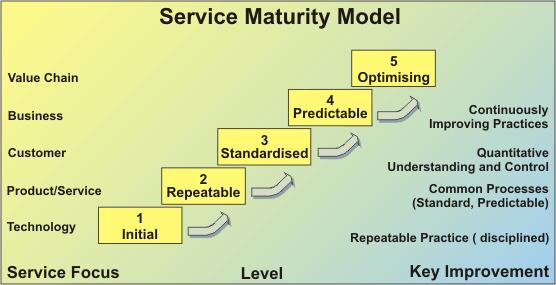
Ok, so you've implemented your ITIL process(es) and feeling good about yourself and life in general.
So, what's next?
Well, congratulations you're now into the realms of Continuous Service Improvement and what better way to plot your course and measure your progress that to use the Capability Maturity Model.
The Service Maturity Model (SMM) helps answer the questions:-
- How well is my specific service performing?
- Are the culture, processes and supporting technologies all appropriate for what we're trying to achieve?
- In our environment, what is it reasonable for customers to expect?
- Are we meeting the end-to-end needs of the customers?
- The customer should only need to be concerned with the service delivered to them, not how the various components fit together to deliver make up the service.
For instance, they care that Internet is unavailable, rather than that the transparent proxy is the cause. When the customer wants to access an application, identity management, desktop, server and network all contribute to this end.
- What are the key things we should look at to do things better?
- What do I need to do?
- Where do others need to make a contribution to improve the overall customer experience?
- How can I achieve visible improvement without breaking the bank?
- Where do the other components in the overall service?
Do you agree with me - the IT Infrastructure Library is missing a good CMM?
Perhaps they will include one in the 'upgrade' to ITIL that's widely expected in Q4/06?
In the meantime, if you would like to learn more about the Capability Maturity Model - why not click the link below, it will instantly transport you to a nice 5 page PDF file from the University of Melbourne explaining the basics.
In particular check out the detailed appendix on page 5. Very nice!
Learn more about the CMM here...
Did you know? Dr. ITIL contains several other articles on CMM. Please use the Google Search Bar to track them down (at the top of this page).
Getting it(IL) off your chest...
We received this very interesting (anonymous) comment on Dr. ITIL yesterday and I've reproduced an edited version of it here (for your viewing pleasure) to highlight that we do read your comments and like to consider your views in helping to shape the content of this site.
One reader provided some really interesting insights into the "Alignability" post we put out a few days ago...
Have a read and see if you agree... why not post your own comment to add to the debate?
"Dr. ITIL, I was extremely curious about your discussion of the Alignability Model from HP. (Editors note - it is actually produced by Service Management Partners INC and implemented via country specific implementation partners).
Having been through ITIL implementations for Global 1000 companies on four continents over the past eight years, most of them outside of the U.S., I just couldn't imagine such a thing being possible.
I found myself thinking, "...I wonder if it really works!", so I went to analyze the model.
After reviewing just the service support high level process designs of the model I would say that such a thing is still not possible... for most enterprise class firms.
For smaller cooky cutter companies lacking the type of complexity often seen in global enterprises with lots of legacy in their environment and lots of organizational issues, the Alignability Model would appear to be useful, and shortcut much of the time consumed by defining future state processes.
However, I actually spent the time to compare some of the previous processes that came out of some of the global implementations that I've been part of, and not one could have been stuffed into the Alignability Model.Global organizations are most often sprawling matrixes of non-standardized desktops, custom built applications and legacy systems, with organizational structures that often simply cannot support moving to the models shown in the Alignability tool within a 30, or even a 90 day implementation window.
Take a recent company as an example. It runs well over 200 applications, 35 of which are busines critical, and only 5 of those are standard applications. Everything else is a custom built system or tool.
They have a new org structure that was assumed within the past 18 months that places nearly 15 customer facing support organizations in charge of their specific applications or infrastructure support.
They are not about to reorg again, and the service desk does not contain a level of knowledge even remotely close to what is required to be able to even ask the right questions about most applications, let alone actually attempt to support them. To move this organization to a single point of entry model within 30-90 days would be suicide for every part of the support organization. Not only would they have a customer revolt on their hands, but the numbers of every support organization would plummet.
My advice to those people looking at the Alignability Model is BEWARE. If you are a smaller company using standardized applications, with a great amount of application support capability in your service desk already, perhaps the Alignability Model is for you.
If not, don't be fooled, my money is on the fact that you would spend as much time attempting to tweak the model as you would designing your future state processes from scratch.
Thanks for letting me get this off my chest! "
What's your view on the model and these comments? Have your say - write a post...
One reader provided some really interesting insights into the "Alignability" post we put out a few days ago...
Have a read and see if you agree... why not post your own comment to add to the debate?
"Dr. ITIL, I was extremely curious about your discussion of the Alignability Model from HP. (Editors note - it is actually produced by Service Management Partners INC and implemented via country specific implementation partners).
Having been through ITIL implementations for Global 1000 companies on four continents over the past eight years, most of them outside of the U.S., I just couldn't imagine such a thing being possible.
I found myself thinking, "...I wonder if it really works!", so I went to analyze the model.
After reviewing just the service support high level process designs of the model I would say that such a thing is still not possible... for most enterprise class firms.
For smaller cooky cutter companies lacking the type of complexity often seen in global enterprises with lots of legacy in their environment and lots of organizational issues, the Alignability Model would appear to be useful, and shortcut much of the time consumed by defining future state processes.
However, I actually spent the time to compare some of the previous processes that came out of some of the global implementations that I've been part of, and not one could have been stuffed into the Alignability Model.Global organizations are most often sprawling matrixes of non-standardized desktops, custom built applications and legacy systems, with organizational structures that often simply cannot support moving to the models shown in the Alignability tool within a 30, or even a 90 day implementation window.
Take a recent company as an example. It runs well over 200 applications, 35 of which are busines critical, and only 5 of those are standard applications. Everything else is a custom built system or tool.
They have a new org structure that was assumed within the past 18 months that places nearly 15 customer facing support organizations in charge of their specific applications or infrastructure support.
They are not about to reorg again, and the service desk does not contain a level of knowledge even remotely close to what is required to be able to even ask the right questions about most applications, let alone actually attempt to support them. To move this organization to a single point of entry model within 30-90 days would be suicide for every part of the support organization. Not only would they have a customer revolt on their hands, but the numbers of every support organization would plummet.
My advice to those people looking at the Alignability Model is BEWARE. If you are a smaller company using standardized applications, with a great amount of application support capability in your service desk already, perhaps the Alignability Model is for you.
If not, don't be fooled, my money is on the fact that you would spend as much time attempting to tweak the model as you would designing your future state processes from scratch.
Thanks for letting me get this off my chest! "
What's your view on the model and these comments? Have your say - write a post...
ITIL be alright on the Night
Lot's of excellent ITIL articles (and article tITIL's!) coming through the media in August, this one by Sue Bushell (www.cio.com.au) rings very true for me personally.
Sue covers:-
- ITIL scepticism
- ITIL history
- Governments 'love' of ITIL
- ITIL use and adoption
- Lessons learnt
- Cultural issues
As well as touching on these central themes Sue also regularly quotes people who have implemented ITIL and reveals their (sometimes) telling comments about the risks and considerations that need to be managed to make your ITIL Implementation a big success.
One particular comment struck a chord with me, as stated by one interviewee:-
""It would have been a real help if ITIL had more practical real-life examples and extracts of service catalogues and CMDBs."
I couldn't agree more. After a few weeks in the Editors chair at Dr. ITIL, we've come to the conclusion that real tangible examples are just not out there at the moment for public consumption. We have found some flavours of Service Catalogs (Use Google Search at the top of this page to find them in Dr. ITIL) but a complete guide to creating your CMDB (along with hints on data structures mapped to ITIL Process flows) is no where to be seen.
Can you help?
If you have found any quality CMDB links - or you have a "How To" guide ready to go - please post a comment below and we'll do the follow-up reseach and post it for the benefit of other CMDB practitioners.
Access Sue's full article here
Sue covers:-
- ITIL scepticism
- ITIL history
- Governments 'love' of ITIL
- ITIL use and adoption
- Lessons learnt
- Cultural issues
As well as touching on these central themes Sue also regularly quotes people who have implemented ITIL and reveals their (sometimes) telling comments about the risks and considerations that need to be managed to make your ITIL Implementation a big success.
One particular comment struck a chord with me, as stated by one interviewee:-
""It would have been a real help if ITIL had more practical real-life examples and extracts of service catalogues and CMDBs."
I couldn't agree more. After a few weeks in the Editors chair at Dr. ITIL, we've come to the conclusion that real tangible examples are just not out there at the moment for public consumption. We have found some flavours of Service Catalogs (Use Google Search at the top of this page to find them in Dr. ITIL) but a complete guide to creating your CMDB (along with hints on data structures mapped to ITIL Process flows) is no where to be seen.
Can you help?
If you have found any quality CMDB links - or you have a "How To" guide ready to go - please post a comment below and we'll do the follow-up reseach and post it for the benefit of other CMDB practitioners.
Access Sue's full article here
ITIL Gets its Turn on the Dancefloor !

Saturday nITIL Fever - It's ITIL's turn on the dancefloor!
We uncovered this really great article last week by Mark Holland writing for CIO Magazine (www.cio.com.au) entitled "ITIL Thoughts" but there was a line a few paragraphs in that really made us laugh, it reads...
"ITIL, so long an industry wallflower, is about to get its turn on the dance floor."
Here in the office, we all had the same thought, at the same time, hence the image above!!
Now, we're not comparing ITIL to John Travolta in any way (no John's far to slick for that!) but I guess implementing ALL of ITIL successfully would make you want to dance around and wave your arm in the air!
Seriously though, Mark's article is very interesting and before you cut to the link and read it all take note along the way of his key points:-
- One US company recently signed a $1 million consulting contract to implement ITIL across its enterprise
- Leading computer maker Dell has just requested 1000 sets of ITIL books for its staff
- Microsoft now has 3000 ITIL-trained staff around the world
So, clearly ITIL is building huge momentum in the US right now - we will have forthcoming articles about ITIL adoption in India, China and Japan soon...
FREE - "Introduction to ITIL" Guide
Fancy learning what ITIL is - but need a no nonsense, practical and business like guide?
Did you think ITIL was just about Service Delivery or Service Support?
We present a link to the ITsmf (www.itsmf.com) who provide free access to an ITIL Introductionary guide covering:-
- What is Service Management?
- Why implement Service Management?
- What is ITIL?
- ICT Infrastructure Management
- The Business Perspective
- Security Management
- Related Standards
- Further guidance
It's also a great introduction to the other core components of ITIL.
Download your FREE Introductory Guide to ITIL here
Learn more:- full set of ITIL core texts, take a look here
Did you think ITIL was just about Service Delivery or Service Support?
We present a link to the ITsmf (www.itsmf.com) who provide free access to an ITIL Introductionary guide covering:-
- What is Service Management?
- Why implement Service Management?
- What is ITIL?
- ICT Infrastructure Management
- The Business Perspective
- Security Management
- Related Standards
- Further guidance
It's also a great introduction to the other core components of ITIL.
Download your FREE Introductory Guide to ITIL here
Learn more:- full set of ITIL core texts, take a look here
What to Expect From Your ITIL Implementation
I caught an article yesterday, originally published in www.express-computer.com (India's only IT Business Weekly!) after researching how ITIL adoption was progressing in India.
Obviously with the proliferation of Indian Call Centers and massive investment by the big 5 IT power houses over the last 3 years - there's going to have to be a massive need for ITIL in India too!
The capability to deliver world class service, consistently meet SLA's and drive down costs further for the benefit of western clients is important for the long term development and growth of India's economy.
For example, with the excellent ongoing success stories coming out of Bangalore it's no wonder that faith in Indian Organizations is now being extended into Back-Office and Mid-Office functions by the IT giants.
It's very interesting to read what the expectation is about ITIL implementation though:-
- It helps reduce costs when developing procedures and practices within an organisation
- It reassures customers that the services are being provided in accordance with documented procedures that can be audited
- It also provides feedback from SLA monitoring
- It facilitates co-operation between a service provider and the client organization
- It substantially reduces the risk of not meeting business requirements for IT services
I don't necessarily agree that all these benefits will be realised with ITIL - unless you specifically set out to achieve those objectives through your ITIL Implementation.
They don't come guaranteed just because it's ITIL-like processes, procedures and the like you're implementing!
Anyway, why not take a look at the full article and decide for yourself...
Learn More Here
Obviously with the proliferation of Indian Call Centers and massive investment by the big 5 IT power houses over the last 3 years - there's going to have to be a massive need for ITIL in India too!
The capability to deliver world class service, consistently meet SLA's and drive down costs further for the benefit of western clients is important for the long term development and growth of India's economy.
For example, with the excellent ongoing success stories coming out of Bangalore it's no wonder that faith in Indian Organizations is now being extended into Back-Office and Mid-Office functions by the IT giants.
It's very interesting to read what the expectation is about ITIL implementation though:-
- It helps reduce costs when developing procedures and practices within an organisation
- It reassures customers that the services are being provided in accordance with documented procedures that can be audited
- It also provides feedback from SLA monitoring
- It facilitates co-operation between a service provider and the client organization
- It substantially reduces the risk of not meeting business requirements for IT services
I don't necessarily agree that all these benefits will be realised with ITIL - unless you specifically set out to achieve those objectives through your ITIL Implementation.
They don't come guaranteed just because it's ITIL-like processes, procedures and the like you're implementing!
Anyway, why not take a look at the full article and decide for yourself...
Learn More Here
ITIL and the Business Perspective
If we didn't have Customers - we wouldn't have a job. So probably a good idea to cast your eyes over this presentation!
At the end of the day - IT Service Management is all about delivering world class service to Customers. Oftentimes our Customers are not just the end consumers of our businesses products and services but the business units themselves - the so-called internal Customers. They expect quality delivery too. Sometimes they are even more demanding, due to their proximity, but that's another article!
The core IT Infrastructure Library gave birth to "The Business Perpsective" this year which was published to help IT Service Providers ensure that they are aligned with their Business and interfacing effectively.
Some business folks we know may also have borrowed a copy to learn a thing or too about what life's like in a Service Delivery organization. There's some common challenges... but hey... ITIL's acronym starts with IT right?!
Colin Rudd (www.itemsltd.co.uk) has produced a insightful presentation pack (PDF) on the Business perspective of IT Service Delivery. The 25 page pack is full of "a picture paints a thousand words" stlye charts, specfically covering:-
- Concepts
- The Value of IT
- Unified Matrix Management
- Value Chains and Governance
- Business / IS Alignment
- Understanding the Business Viewpoint
- Managing the Provision of Service
The Pack also includes a complete Process Model which outlines how IT Service can align itself with the Business. There's a great 45 process step chart near the end as well that positions the Service Support and Service Delivery functions within the overall context of Business Alignment, through to the underpinning Supplier service.
Learn More About Business Alignment Here
At the end of the day - IT Service Management is all about delivering world class service to Customers. Oftentimes our Customers are not just the end consumers of our businesses products and services but the business units themselves - the so-called internal Customers. They expect quality delivery too. Sometimes they are even more demanding, due to their proximity, but that's another article!
The core IT Infrastructure Library gave birth to "The Business Perpsective" this year which was published to help IT Service Providers ensure that they are aligned with their Business and interfacing effectively.
Some business folks we know may also have borrowed a copy to learn a thing or too about what life's like in a Service Delivery organization. There's some common challenges... but hey... ITIL's acronym starts with IT right?!
Colin Rudd (www.itemsltd.co.uk) has produced a insightful presentation pack (PDF) on the Business perspective of IT Service Delivery. The 25 page pack is full of "a picture paints a thousand words" stlye charts, specfically covering:-
- Concepts
- The Value of IT
- Unified Matrix Management
- Value Chains and Governance
- Business / IS Alignment
- Understanding the Business Viewpoint
- Managing the Provision of Service
The Pack also includes a complete Process Model which outlines how IT Service can align itself with the Business. There's a great 45 process step chart near the end as well that positions the Service Support and Service Delivery functions within the overall context of Business Alignment, through to the underpinning Supplier service.
Learn More About Business Alignment Here
Welcome to Dr. ITIL - Fresh and Free ITIL Content
Congratulations! You've just found the best ITIL site on the Planet!!
(Well we like to think so!)
A warm welcome to www.dritil.com. My name is Robert Ewloe and I am the daily editor of Dr. ITIL. As a fully qualified ITIL Managers certificate holder (but more importantly an active practitioner in all things ITIL), I know how it must feel to find this site! We now have over 250 specially vetted ITIL related links for your reading pleasure.
We launched in February this year with the specific aim of providing links and FREE information for ITIL experts and beginners alike - in short - we wanted to promote ITIL worldwide!
Well - we've certainly started something! When we went live in February - there was a dreadful lack of ITIL material available - that was the problem then!
Now, there´s been an explosion of interest in ITIL worldwide and half the challenge now is knowing what to read and what´s worthwhile! Erm, that´s where we come in...
Dr. ITIL is edited and produced by a small team of active ITIL experts who between them have over 20 years of specific ITIL implementation and improvement experience in big corporations - plus tons more general service and IT experience. All the links presented are read by us (humans!) and then authorised for publishing.
We have published over 250 links on this site to hundreds of amazing sites across the Internet, including:-
- Free Process Guides, presentations, checklists and reference material
- Free ITIL introductory presentations and ´how to´documents
- Articles on all aspects of ITIL
- Links to special Vendors products and Services (non sponsored)
Can I personally recommend three things to you today:-
1. Please join our mailing list - if you have not already. You will only receive a very brief reminder email when something new and exciting is published. We never use your email address for anything other than telling you what´s new and how to make the most of Dr. ITIL.
Over 720 (and growing daily) ITIL practitioners can´t be wrong!
2. Please use the Google Search at the top of every page to get the most from Dr. ITIL. There´s an article of just about every apsect of ITIL right now... we don´t want you to miss it! Simply use the keywords you require, hit the Dr. ITIL radio button, then search. Over 20% of daily visitors use the search facility effectively everyday.
Some hidden keyword gems:- ITIL exam tips, FITS, Pocket Guide and try the word ´FREE´.
3. Please tell your colleagues about us! Click the "Tell a Friend" icon to recommend Dr. ITIL to someone else. If they work in IT Service they will also benefit tremendously from the content within Dr. ITIL
Finally, if you have any thoughts or suggestions about Dr. ITIL - OR - you have an ITIL related article that you know everone would love - please feel free to email me at info@dritil.com anytime!
Happy ITILíng!
Best Regards,
Robert.
(Well we like to think so!)
A warm welcome to www.dritil.com. My name is Robert Ewloe and I am the daily editor of Dr. ITIL. As a fully qualified ITIL Managers certificate holder (but more importantly an active practitioner in all things ITIL), I know how it must feel to find this site! We now have over 250 specially vetted ITIL related links for your reading pleasure.
We launched in February this year with the specific aim of providing links and FREE information for ITIL experts and beginners alike - in short - we wanted to promote ITIL worldwide!
Well - we've certainly started something! When we went live in February - there was a dreadful lack of ITIL material available - that was the problem then!
Now, there´s been an explosion of interest in ITIL worldwide and half the challenge now is knowing what to read and what´s worthwhile! Erm, that´s where we come in...
Dr. ITIL is edited and produced by a small team of active ITIL experts who between them have over 20 years of specific ITIL implementation and improvement experience in big corporations - plus tons more general service and IT experience. All the links presented are read by us (humans!) and then authorised for publishing.
We have published over 250 links on this site to hundreds of amazing sites across the Internet, including:-
- Free Process Guides, presentations, checklists and reference material
- Free ITIL introductory presentations and ´how to´documents
- Articles on all aspects of ITIL
- Links to special Vendors products and Services (non sponsored)
Can I personally recommend three things to you today:-
1. Please join our mailing list - if you have not already. You will only receive a very brief reminder email when something new and exciting is published. We never use your email address for anything other than telling you what´s new and how to make the most of Dr. ITIL.
Over 720 (and growing daily) ITIL practitioners can´t be wrong!
2. Please use the Google Search at the top of every page to get the most from Dr. ITIL. There´s an article of just about every apsect of ITIL right now... we don´t want you to miss it! Simply use the keywords you require, hit the Dr. ITIL radio button, then search. Over 20% of daily visitors use the search facility effectively everyday.
Some hidden keyword gems:- ITIL exam tips, FITS, Pocket Guide and try the word ´FREE´.
3. Please tell your colleagues about us! Click the "Tell a Friend" icon to recommend Dr. ITIL to someone else. If they work in IT Service they will also benefit tremendously from the content within Dr. ITIL
Finally, if you have any thoughts or suggestions about Dr. ITIL - OR - you have an ITIL related article that you know everone would love - please feel free to email me at info@dritil.com anytime!
Happy ITILíng!
Best Regards,
Robert.
"Shrink Wrapped ITIL" - Ready To Go?
So here's something I've thought about often during my ITIL process implementations - what if someone already had the work instructions, process guides and tool configuration pretty much ready to go? You know, a "Shrink Wrapped" version of ITIL...
As we know, a lot of time, effort, stress and cost within an implementation is taken up on these activities - but in this day and age of instant everything surely a "shrink wrapped box of ITIL" ready to fine tune and plug-in is possible?
Now, don't get me wrong. I know ITIL isn't a tool or a standard or a set of rules you've got to follow (I've been around a bit ;> ) but it just shouldn't be this costly and time consuming. Don't you agree?
Maybe it's me - but within the overall ITIL marketplace - which is very individual and fragmented across the product suites available - there is still a distinct lack of process and work instruction integration to speed up implementations.
From the (by the way - highly recommended) OGC books - we know that ITIL theoretically won't vary much from Industry to Industry when implemented - so why doesn't an instant-on implementation exist - or even nearly exist? or even remotely exist?
Sorry, rant over...
Well, it kind of does now. Actually it kind of has for many years but I've missed it until this week and the chances are - so have you!
So, enter (stage left)... the Alignability™ Process Model.
This provides field-proven IT Service Management processes but currently only for the HP OpenView Service Desk suite (which is a shame as well as a massive market opportunity for the creators).
The Alignability™ processes are based on a combination of the best-practice ITIL methodology and the Total Quality Management principle of continuous improvement.
Where ITIL® provides the theory and guidelines - the Alignability™ Process Model provides the processes, procedures, and detailed work instructions.
It even comes with a set of configuration files that automatically configure the HP OpenView Service Desk application for the support of the Alignability™ processes. The processes and the configuration files for HP OpenView Service Desk dramatically reduce the time required for, and the risks associated with, service management implementation projects.
The Alignability™ Process Model is split into two modules; the "Service Support" module and the "Service Delivery" module. The Service Support module provides the processes required for a solid service management foundation. The six service support processes are:-
-Configuration Management
-Alarm Management
-Incident Management
-Problem Management
-Change Management
-Release Management
The Service Delivery module is targeted at mature service provider organizations. This module contains the following advanced service management processes:-
-Service Level Management
-Availability Management
-Capacity Management
-Continuity Management
The implementation of the service support processes of the Alignability™ Process Model can be completed within 30 days.
This represents a savings of 4 to 6 months. The reason why the Alignability™ Process Model can be implemented so quickly is that it allows organizations to eliminate the process definition phase of their service management implementation projects.
The configuration files, which automatically configure the HP OpenView Service Desk application, also help to reduce the duration of service management implementations, by saving at least 20 more days.
These 20 days are normally required by an experienced technical consultant for the configuration of the application to ensure that it supports the service management processes that the organization has defined.
The 30-day implementation plan is provided with the Alignability™ Process Model to ensure that customers can reliably complete the implementation of the service support processes within 30 days.
The standard implementation plan (which caters for a detailed process review and subsequent customization) is also provided for organizations that do not want to start from scratch, but do not yet feel comfortable enough to commit to a 30-day implementation.
The Alignability™ Process Model was originally developed in 1999 and is maintained by consistently incorporating the ideas from each implementation into the next version of the model. The model has already been deployed by more than 100 organizations in over 30 countries in a wide variety of industries.
The Alignability™ Process Model is an HP OpenView Authorized Product.
Just before you dive in... something to think about... give this site a few minutes... click around and select a few menu options... the power of this is not immediately obvious but it's there!
Learn much more about Alignability here
As we know, a lot of time, effort, stress and cost within an implementation is taken up on these activities - but in this day and age of instant everything surely a "shrink wrapped box of ITIL" ready to fine tune and plug-in is possible?
Now, don't get me wrong. I know ITIL isn't a tool or a standard or a set of rules you've got to follow (I've been around a bit ;> ) but it just shouldn't be this costly and time consuming. Don't you agree?
Maybe it's me - but within the overall ITIL marketplace - which is very individual and fragmented across the product suites available - there is still a distinct lack of process and work instruction integration to speed up implementations.
From the (by the way - highly recommended) OGC books - we know that ITIL theoretically won't vary much from Industry to Industry when implemented - so why doesn't an instant-on implementation exist - or even nearly exist? or even remotely exist?
Sorry, rant over...
Well, it kind of does now. Actually it kind of has for many years but I've missed it until this week and the chances are - so have you!
So, enter (stage left)... the Alignability™ Process Model.
This provides field-proven IT Service Management processes but currently only for the HP OpenView Service Desk suite (which is a shame as well as a massive market opportunity for the creators).
The Alignability™ processes are based on a combination of the best-practice ITIL methodology and the Total Quality Management principle of continuous improvement.
Where ITIL® provides the theory and guidelines - the Alignability™ Process Model provides the processes, procedures, and detailed work instructions.
It even comes with a set of configuration files that automatically configure the HP OpenView Service Desk application for the support of the Alignability™ processes. The processes and the configuration files for HP OpenView Service Desk dramatically reduce the time required for, and the risks associated with, service management implementation projects.
The Alignability™ Process Model is split into two modules; the "Service Support" module and the "Service Delivery" module. The Service Support module provides the processes required for a solid service management foundation. The six service support processes are:-
-Configuration Management
-Alarm Management
-Incident Management
-Problem Management
-Change Management
-Release Management
The Service Delivery module is targeted at mature service provider organizations. This module contains the following advanced service management processes:-
-Service Level Management
-Availability Management
-Capacity Management
-Continuity Management
The implementation of the service support processes of the Alignability™ Process Model can be completed within 30 days.
This represents a savings of 4 to 6 months. The reason why the Alignability™ Process Model can be implemented so quickly is that it allows organizations to eliminate the process definition phase of their service management implementation projects.
The configuration files, which automatically configure the HP OpenView Service Desk application, also help to reduce the duration of service management implementations, by saving at least 20 more days.
These 20 days are normally required by an experienced technical consultant for the configuration of the application to ensure that it supports the service management processes that the organization has defined.
The 30-day implementation plan is provided with the Alignability™ Process Model to ensure that customers can reliably complete the implementation of the service support processes within 30 days.
The standard implementation plan (which caters for a detailed process review and subsequent customization) is also provided for organizations that do not want to start from scratch, but do not yet feel comfortable enough to commit to a 30-day implementation.
The Alignability™ Process Model was originally developed in 1999 and is maintained by consistently incorporating the ideas from each implementation into the next version of the model. The model has already been deployed by more than 100 organizations in over 30 countries in a wide variety of industries.
The Alignability™ Process Model is an HP OpenView Authorized Product.
Just before you dive in... something to think about... give this site a few minutes... click around and select a few menu options... the power of this is not immediately obvious but it's there!
Learn much more about Alignability here
Ready to Create your IT Service Catalog?
Dr. ITIL is very pleased to publish this excellent article on IT Service Catalogs, including seven key steps to create your catalog and how to refine your catalog once it's created.
Ready to Create Your IT Service Catalog?
By Kevin LeBlanc.
Many experts agree that one of the first steps in running IT like a service-oriented business is to implement a usable service catalog. Adopting an IT catalog of services in alignment with an ITIL based service level management process can optimize service provision to the business while reducing the overall costs of IT service support and delivery.
Although many IT organizations have yet to formally publish their service offerings (let alone charge IT services back to the business), industry analysts now see IT service catalog adoption increasing.
But how is a service catalog is created? Which services should be included? And who should be involved in the process?
There are many benefits to the service catalog, but perhaps the most important driver is promoting continued relationship building between IT organizations and customers. Overall benefits of deploying a formal service catalog will differ depending on the organization, but should potentially include:
•Significant improvement in internal and external communications
•Foster a better understanding of business requirements and challenges
•Ability to allocate and match costs to specific business departments / units
•Allow competitive benchmarking against third party service providers
•Positively (and significantly) alter end-user consumption and behavior
•Increase demand awareness and visibility into IT service provision
•Reduce IT service and process inefficiencies redundancies
•Reallocation of IT resources to critical business systems
•Lower service provision error rates
•IT operational cost reductions
Creating the IT Service Catalog
The actual analysis, development and deployment of an IT service catalog can be daunting if approached with the intent of documenting attributes of all services pertaining to every customer. But a tactical and useful IT service catalog should not require a tremendous amount of effort-- in many situations, it may prove valuable to first pilot the catalog in order to determine which services and attributes need to be added or revised prior to the more comprehensive rollout.
Publishing the initial service catalog without chargeback, targeting a specific business unit or covering only a few primary IT services may allow for refinement and iterative maturity over time. But regardless of the scope of services included in the initial rollout, the catalog should be clearly written and focus on business value. In order to accomplish this, the following activities should be aligned with an IT organizations overall goals and objectives:
Establish Team: The initial catalog should be driven internally within IT and include adequate representation from all stakeholders within each domain to ensure documented services are appropriate and valid; executive sponsorship is also critical.
Establish Baseline: The team should create a list of all services IT offers, regardless of whether they will be included in the initial catalog of services. When creating the baseline catalog, it is important to consider the following key guidelines to ensure services offered can be effectively managed going forward:
•The service is self-contained and is not part of a larger service offering
•The service can be monitored and measured for consumption levels
•The service has costs that may vary with changes in consumer behavior
•The business could potentially procure the service externally
Refine Service Offerings: The initial baseline should be refined to include only those initial services to be included in the pilot or first iteration of the IT service catalog. If different levels of service will be provided, cost variations should be documented by consumption type.
Perform Service Benchmarks: Once services have been identified, service levels should be benchmarked using available monitoring capabilities and measurement techniques. Resultant metrics should be documented to ensure they are consistent and repeatable for incorporation into service level agreements with the customer.
Publish Service Catalog: After services are documented, reviewed and finalized, the service catalog should be made available to the business, preferably through an appropriate business relationship manager. Business feedback may be incorporated into the catalog and revised prior to service selection and establishing formal agreements.
Establish Service Agreement: Following business review and selection of services, any formal service selections and supporting agreements should be facilitated through the service level management process and documented in a standard service level agreement (SLA); service narratives may be used to define and continuously update service descriptions.
Improve Services: Any service improvement initiative should be iterative in nature and ensure ongoing improvement activities enhance communication with the business. Maximize operational efficiencies and continue cost reductions through a continuous service improvement program (CSIP).
Refining the Service Catalog
The cost, complexity and difficulty of implementing an IT service catalog will vary greatly depending on the details incorporated into the final document.
Therefore, different variations of the service catalog should be considered only after an initial catalog has been deployed successfully and accepted by the business customer.
Incorporating more detail and variation to the catalog can add significant additional value to the business and the IT organization. Some of these variations and enhancements to the catalog may include:
•Using uniform charges for a services (e.g. per server, person or business unit)
•Establishing usage or capacity-based charges (e.g. by GB or number of service calls)
•Adding incentives for consuming fewer services or units in a cycle
•Establishing tiered service offering of similar services (e.g. gold vs. silver service)
•Processes and procedures for procuring new services or adding additional customers
The Bottom Line: Most companies have not yet created IT service catalogs, let alone implement chargeback to the business for IT services. However, adoption of an IT catalog of services in alignment with the service level management process can promote rapid maturity of IT business relationship management practices. The deployment of an effective IT service catalog will not only clarify IT services to the business, but can significantly modify consumer behavior resulting in streamlined service consumption and overall cost reduction.
Kevin LeBlanc is a Process Excellence Consultant with ProcessWorx (www.processworx.com).
Kevin holds a M.S. degree in MIS and has 15 years experience as an Information Technology professional specializing in operational process improvement, service management and legislative compliance. Kevin can be reached at kleblanc@processworx.com.
Have you got an ITIL related article that you believe visitors to Dr. ITIL would enjoy? Please send your article for publishing approval to info@dritil.com
Ready to Create Your IT Service Catalog?
By Kevin LeBlanc.
Many experts agree that one of the first steps in running IT like a service-oriented business is to implement a usable service catalog. Adopting an IT catalog of services in alignment with an ITIL based service level management process can optimize service provision to the business while reducing the overall costs of IT service support and delivery.
Although many IT organizations have yet to formally publish their service offerings (let alone charge IT services back to the business), industry analysts now see IT service catalog adoption increasing.
But how is a service catalog is created? Which services should be included? And who should be involved in the process?
There are many benefits to the service catalog, but perhaps the most important driver is promoting continued relationship building between IT organizations and customers. Overall benefits of deploying a formal service catalog will differ depending on the organization, but should potentially include:
•Significant improvement in internal and external communications
•Foster a better understanding of business requirements and challenges
•Ability to allocate and match costs to specific business departments / units
•Allow competitive benchmarking against third party service providers
•Positively (and significantly) alter end-user consumption and behavior
•Increase demand awareness and visibility into IT service provision
•Reduce IT service and process inefficiencies redundancies
•Reallocation of IT resources to critical business systems
•Lower service provision error rates
•IT operational cost reductions
Creating the IT Service Catalog
The actual analysis, development and deployment of an IT service catalog can be daunting if approached with the intent of documenting attributes of all services pertaining to every customer. But a tactical and useful IT service catalog should not require a tremendous amount of effort-- in many situations, it may prove valuable to first pilot the catalog in order to determine which services and attributes need to be added or revised prior to the more comprehensive rollout.
Publishing the initial service catalog without chargeback, targeting a specific business unit or covering only a few primary IT services may allow for refinement and iterative maturity over time. But regardless of the scope of services included in the initial rollout, the catalog should be clearly written and focus on business value. In order to accomplish this, the following activities should be aligned with an IT organizations overall goals and objectives:
Establish Team: The initial catalog should be driven internally within IT and include adequate representation from all stakeholders within each domain to ensure documented services are appropriate and valid; executive sponsorship is also critical.
Establish Baseline: The team should create a list of all services IT offers, regardless of whether they will be included in the initial catalog of services. When creating the baseline catalog, it is important to consider the following key guidelines to ensure services offered can be effectively managed going forward:
•The service is self-contained and is not part of a larger service offering
•The service can be monitored and measured for consumption levels
•The service has costs that may vary with changes in consumer behavior
•The business could potentially procure the service externally
Refine Service Offerings: The initial baseline should be refined to include only those initial services to be included in the pilot or first iteration of the IT service catalog. If different levels of service will be provided, cost variations should be documented by consumption type.
Perform Service Benchmarks: Once services have been identified, service levels should be benchmarked using available monitoring capabilities and measurement techniques. Resultant metrics should be documented to ensure they are consistent and repeatable for incorporation into service level agreements with the customer.
Publish Service Catalog: After services are documented, reviewed and finalized, the service catalog should be made available to the business, preferably through an appropriate business relationship manager. Business feedback may be incorporated into the catalog and revised prior to service selection and establishing formal agreements.
Establish Service Agreement: Following business review and selection of services, any formal service selections and supporting agreements should be facilitated through the service level management process and documented in a standard service level agreement (SLA); service narratives may be used to define and continuously update service descriptions.
Improve Services: Any service improvement initiative should be iterative in nature and ensure ongoing improvement activities enhance communication with the business. Maximize operational efficiencies and continue cost reductions through a continuous service improvement program (CSIP).
Refining the Service Catalog
The cost, complexity and difficulty of implementing an IT service catalog will vary greatly depending on the details incorporated into the final document.
Therefore, different variations of the service catalog should be considered only after an initial catalog has been deployed successfully and accepted by the business customer.
Incorporating more detail and variation to the catalog can add significant additional value to the business and the IT organization. Some of these variations and enhancements to the catalog may include:
•Using uniform charges for a services (e.g. per server, person or business unit)
•Establishing usage or capacity-based charges (e.g. by GB or number of service calls)
•Adding incentives for consuming fewer services or units in a cycle
•Establishing tiered service offering of similar services (e.g. gold vs. silver service)
•Processes and procedures for procuring new services or adding additional customers
The Bottom Line: Most companies have not yet created IT service catalogs, let alone implement chargeback to the business for IT services. However, adoption of an IT catalog of services in alignment with the service level management process can promote rapid maturity of IT business relationship management practices. The deployment of an effective IT service catalog will not only clarify IT services to the business, but can significantly modify consumer behavior resulting in streamlined service consumption and overall cost reduction.
Kevin LeBlanc is a Process Excellence Consultant with ProcessWorx (www.processworx.com).
Kevin holds a M.S. degree in MIS and has 15 years experience as an Information Technology professional specializing in operational process improvement, service management and legislative compliance. Kevin can be reached at kleblanc@processworx.com.
Have you got an ITIL related article that you believe visitors to Dr. ITIL would enjoy? Please send your article for publishing approval to info@dritil.com
Subscribe to:
Posts (Atom)


 Posts
Posts

